Buckinghamshire Council manages one of the UK's largest and most complex local highways networks, spanning approximately 3,200 km of roads, 30,000+ streetlights, 85,000 gullies and more than 700 structures and bridges. The network has a valuation of approximately £4.2bn, with around 250 people working across the highways service.
In 2023, Buckinghamshire launched a new highways service, creating an opportunity to rethink how it managed its data, systems and day-to-day operations. As part of this transformation, the council chose Causeway as its technology partner, adopting CausewayOne Asset Management, CausewayOne Network and adding CausewayOne Asset Strategy in 2025.
Today, these solutions form part of a wider digital ecosystem connecting council teams, contractors, strategic planning and public-facing services.

The Challenge
When Buckinghamshire launched its new highways service in 2023, it wanted greater control over its asset data and more flexibility to adapt systems and workflows as the service evolved.
Before this, the highways service was fully outsourced and its provider used a traditional asset management system. While it supported the service, it was relatively rigid and did not give Buckinghamshire the flexibility it wanted.
The council also needed its asset management platform to work alongside a much wider technology environment, including contractor systems, network management, strategic asset planning, GIS and customer-facing platforms.
The ambition was to create a flexible, connected platform that could bring data together and evolve with the service.
The Solution
One connected highways ecosystem
Buckinghamshire has built a wider digital ecosystem around CausewayOne Asset Management, using its open API to connect data and workflows across internal systems, contractors and public-facing platforms.
"CausewayOne's open API was important to us because it enabled us to ensure that no matter what the endpoint is for the user, a stakeholder, a member of staff on the ground, we're able to get all the information to them as they needed to."
Christopher Anousis, Network Strategy Manager, Buckinghamshire Council
Connecting the systems that matter
Contractor delivery
Integration with Balfour Beatty Living Places's works management system has evolved from a basic exchange of jobs into a bi-directional flow of information. Query codes, KPI exemption requests and performance data can move between systems, giving both sides greater visibility and reducing the need for retrospective reporting.
Customer reports
Public enquiries reported through FixMyStreet flow directly into CausewayOne Asset Management and can be linked to the relevant job. Customers can then receive automatic updates throughout the lifecycle of the work, from scheduling through to completion.
Capital programmes
SharePoint and Microsoft Power Automate are used to maintain Buckinghamshire's capital programme data. The master tracker is updated twice a week and synchronised into CausewayOne Asset Management via the API. The same information can then be shared through ArcGIS, allowing stakeholders to view relevant programme information.
The result is a connected flow of information, reducing manual handling and helping teams, contractors and stakeholders work from the same data.
Building the tools the service needs
Buckinghamshire has also developed a self-serve approach, giving its teams the flexibility to shape CausewayOne around the way the service operates.
"Being able to build our own hubs and designs within CausewayOne means that the service can move forward, and we're not held back by the software that we're using."
Christopher Anousis, Network Strategy Manager, Buckinghamshire Council
The council has trained internal super users who can create dashboards, designs and workflows themselves, while its Alliance Shared Data approach ensures information is provided in a consistent, standardised format regardless of which provider generates it.
This means Buckinghamshire can:
- Create new designs as services change
- Build dashboards around emerging operational needs
- Adapt workflows without relying on external development or consultancy
- Standardise data across the wider highways ecosystem
Operational visibility and smarter workload management
The combination of Hubs (custom dashboards that bring together live operational information), and Boards (visual tools that help teams manage and allocate workloads), is helping Buckinghamshire turn connected data into practical, day-to-day decision making
Each of the council's four area teams has its own Hub, bringing together live information across customer enquiries, inspections, scheduled works, drainage and gully programmes and other priorities.
"By putting all the key data and analytics in our Hubs and dashboards, we’ve enabled the team to manage the services and assets they’re responsible for more effectively and in a more focused way."
Kit Gordon-Stuart, Senior Contracts Officer, Buckinghamshire Council
Using live data to manage demand
During a significant increase in pothole enquiries, Buckinghamshire created a dedicated Winter Hub to monitor demand and service performance in real time. Pothole enquiries more than doubled, from 3,344 in January 2025 to 7,300 in January 2026, putting significant pressure on the service and its term maintenance contractor.
The Hub provides a rolling five-day view of enquiries received, jobs raised and work completed, allowing the team to see whether work is keeping pace with demand, identify when a backlog is building and monitor progress as the service responds.
Turning operational data into senior reporting
Buckinghamshire's SitRep Hub brings together information for Cabinet Members and senior officers, including jobs raised, emergency work, KPI exemptions and planned works.
Previously, producing this type of update involved running seven or eight separate reports and checking the data manually. By bringing the information together in one Hub, Buckinghamshire now achieves:
- 2–3 hours saved per report – by bringing information together in one Hub, rather than running seven or eight separate reports and checking the data manually.
Live data can also be accessed directly in meetings, giving managers and senior stakeholders a more current view of service performance.
Boards – turning visibility into action
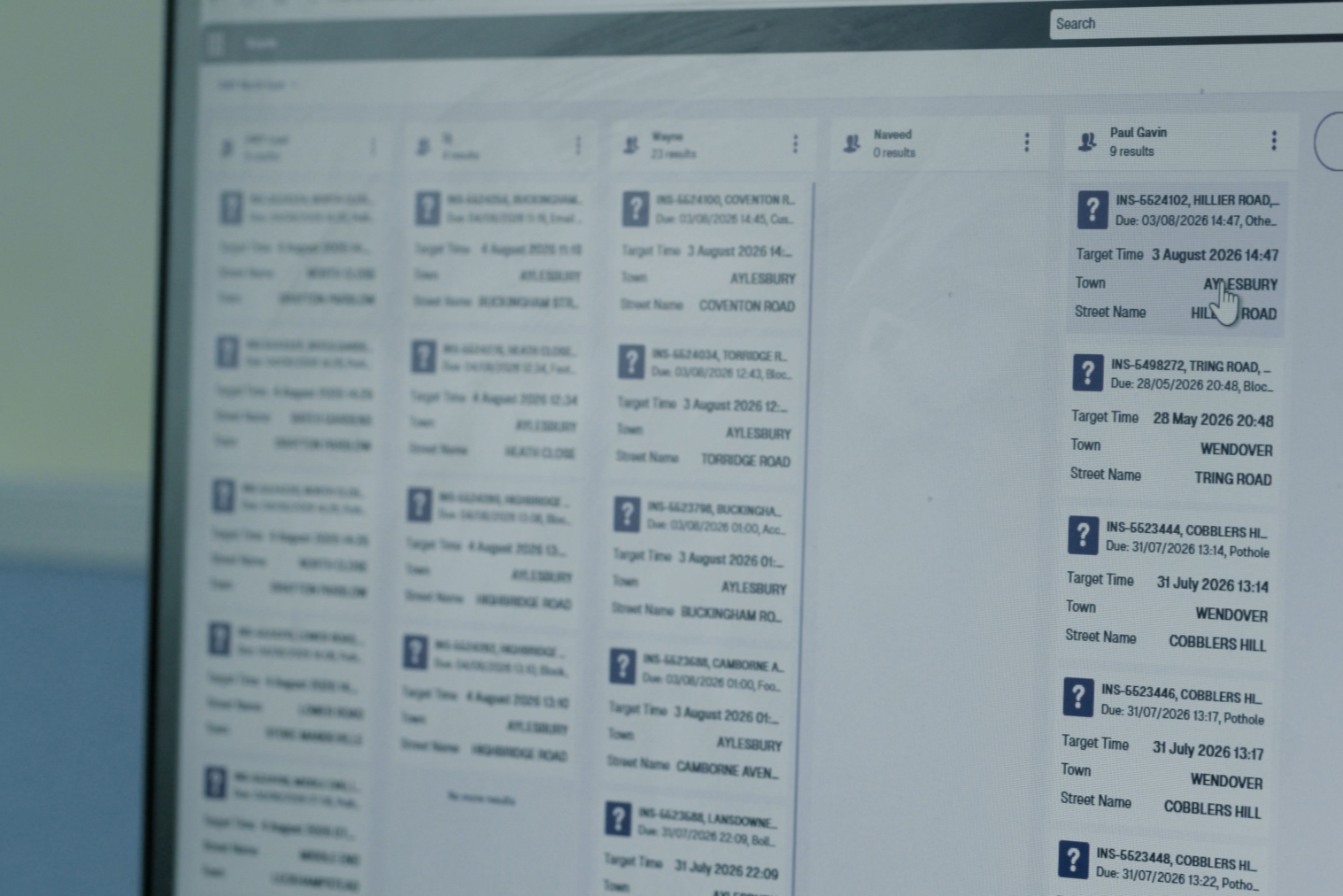
While Hubs provide the bigger picture, Boards help teams act on it. Area leads can see workloads and move enquiries between inspectors using a simple drag-and-drop approach.
For Buckinghamshire, this has significantly reduced the time involved in allocating work:
- 15 minutes → seconds – time taken to reallocate an enquiry
- 30 minutes → 10 minutes – time taken to allocate annual inspections, a 66% reduction
For Grant Weaving, Highways Lead, the latter process saves around 20 minutes per allocation, freeing up time for other higher priority work.
Together, Hubs and Boards are helping Buckinghamshire move from simply seeing what is happening across the network to actively managing workloads and changing demand.
Strategic asset management and long-term planning
While Hubs and Boards are helping Buckinghamshire manage the network day to day, CausewayOne Asset Strategy and CausewayOne Asset Management work together to support longer-term decisions about where and when investment is needed.
Buckinghamshire uses CausewayOne Asset Strategy to bring together condition and survey data to support its capital maintenance programme. This includes SCRIM, SCANNER, AI and footway surveys, alongside accident data, helping the council build a picture of network condition and identify investment priorities.
"We use technical data from CausewayOne Asset Strategy to identify where investment is needed, then bring that information into CausewayOne Asset Management so our teams can investigate those sites in the field. That gives us a much more connected approach to understanding our network and planning our capital programme."
Michael Vallee, Road Network Lead Technician, Buckinghamshire Council
From condition data to field investigations
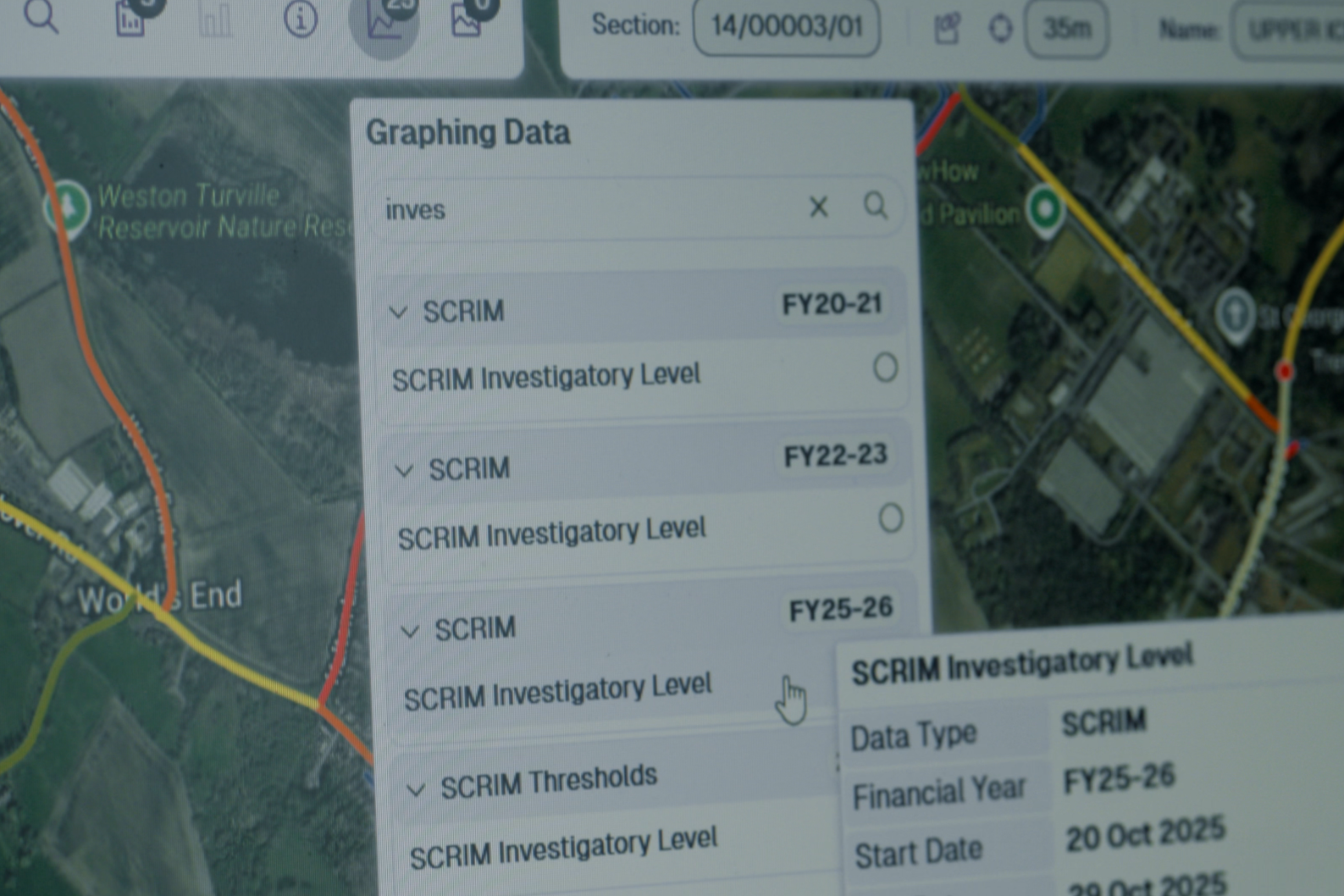
One example is Buckinghamshire’s use of SCRIM data. In CausewayOne Asset Strategy, the council runs a SCRIM prioritisation model that follows their Skid Resistance Strategy to identify and grade sites according to severity, helping the team focus on the most critical locations for further investigation.
Those sites can then be pushed into CausewayOne Asset Management, where field teams use the mobile app to complete a site investigation form. Pre-populated questions, dropdown options and the ability to upload photographs make it quicker and easier to capture consistent information while on site. Once an investigation is complete, the team can raise a job in CausewayOne Asset Management for any necessary work.
Using operational data to inform investment
The connection between the two solutions also means operational information can support strategic planning. Defect information from CausewayOne Asset Management feeds into CausewayOne Asset Strategy, where it is combined with condition data to provide additional evidence for capital programme planning and help prioritise recommended schemes.
This gives Buckinghamshire a more connected view of its network, bringing together condition data, defects and on-the-ground investigations to support investment decisions.
Supporting DfT transparency and funding requirements
CausewayOne is also helping Buckinghamshire meet DfT transparency requirements by bringing together the evidence needed to demonstrate how its network is being managed and maintained.
The platform provides a single source of truth for information covering areas including network condition, assets, potholes and defects, maintenance spending and future maintenance plans.
"CausewayOne has really helped us to clearly and quickly collate the information and evidence to produce this year’s transparency report."
Chad Baker, Asset Management Consultant, AtkinsRéalis
Supporting access to additional funding
Buckinghamshire has access to £5.484 million in additional DfT funding for 2025–26, with approximately £1.37 million – 25% – held back pending demonstration of the relevant transparency criteria.
By reducing duplication and improving the consistency of its evidence, CausewayOne is helping Buckinghamshire support funding discussions and take a more proactive approach to asset management.
Smarter network coordination with CausewayOne Network
CausewayOne Network helps Buckinghamshire coordinate road space, manage closures and diversions, and give residents and delivery partners greater visibility of activity across the network.

Streamlining road closures and diversions
Buckinghamshire can:
- Plan road closures and diversion routes in one system
- Automatically generate optimal diversion routes
- Carry diversion information directly into the Traffic Management plan
- Automatically inherit diversion information when creating a TTRO, removing the need to redraw it
This creates a more connected workflow from initial road-space planning through to the temporary traffic order.
Giving residents better information
Residents can use CausewayOne Network to view:
- Road closures and diversion routes
- Temporary traffic signals
- Planned works, including dates and times
- Live traffic information
- The reason for planned works
Residents can also set a local notification area – for example, a one-mile radius – to stay informed about works that could affect their journeys.
"CausewayOne Network is very good for residents. They’re able to view the works, road closures and diversion routes, which gives them an opportunity to plan their journeys accordingly."
Lottie Foskett, TTRO Officer, Buckinghamshire Council
The same visibility helps contractors, utility companies and internal teams understand where road space is already committed and coordinate activity around it.
The results
Buckinghamshire's connected approach is delivering measurable improvements across day-to-day operations, reporting and workload management:
- 2x increase in pothole enquiries managed – from 3,344 in January 2025 to 7,300 in January 2026, with the Winter Hub providing live visibility of demand, jobs and completions.
- 2–3 hours saved per SitRep report – replacing seven or eight separate reports and manual data checking with a single Hub.
- 15 minutes → seconds – time taken to reallocate an enquiry using Boards.
- 66% reduction in annual inspection allocation time – from 30 minutes to 10 minutes.
- 20 minutes saved per annual inspection allocation – freeing up time for higher-priority work.
- 3,200 km of network connected – bringing operational, strategic and network management information together across a complex highways service.
Looking ahead
Buckinghamshire is continuing to build on its CausewayOne platform, exploring new ways to connect data, automate processes and support a more proactive highways service.
Future developments include:
- Flood resilience – integrating Hydro Master rainfall forecasting to support planning around major rainfall events
- AI-enabled monitoring – exploring automated condition detection and integrating data from emerging survey technologies
- Network automation – exploring D-TRO capabilities within CausewayOne Network, with the potential to simplify submission and approval processes
For Buckinghamshire, the flexibility of CausewayOne means the platform can continue to evolve alongside the service – allowing the council to build new solutions as its needs change.
Want to see how CausewayOne can help you run more efficient, connected services? Speak to our team today.