.png?width=1600&height=1000&name=PRECON%20AI%20webinar%20-%20OnDemand%20Feature%20Image%20(7).png)
Contents
Why is AI becoming such a big topic in pre-construction?
Is AI already being used in estimating?
Will AI replace the estimating role?
Where can AI add value in the estimating process today?
How much time can AI save estimators?
Should I use ChatGPT, Copilot or Claude for estimating?
What are the risks of using generic AI in pre-construction?
Is your business ready for AI?
Still using spreadsheets for estimating?
What should pre-construction leaders do now?
The future of AI in estimating
How does CausewayOne Pre-Construction use AI?
Download the guide to AI in pre-construction
Pre-construction is entering a new phase.
What was once driven by spreadsheets, manual processes, and disconnected workflows is becoming more connected, more data-led, and increasingly shaped by artificial intelligence. For contractors operating under tighter margins and higher expectations, this shift is not optional, it’s rapidly becoming a competitive requirement.
AI is not replacing estimators. It is redefining how they work, where they spend their time, and how effectively they make decisions that influence bid quality and profitability.
- Can AI help us produce better bids?
- Will AI replace estimators?
- Is ChatGPT or Claude safe to use for estimating?
- Can AI help manage subcontractor enquiries?
- How much time could AI actually save?
- What are the risks?
- Where should we start?
The reality is that AI is already being used across pre-construction, but not always in the ways people assume. The greatest opportunity isn't replacing estimators. It's reducing the administrative burden that prevents them from focusing on pricing, risk, value engineering and bid strategy.
In this guide, we'll answer the biggest questions estimators and commercial leaders are asking and explore where AI can genuinely improve pre-construction performance today.
Key takeaways
- AI is helping estimators spend less time on administration and more time on pricing, risk and bid strategy.
- Up to 75% efficiency gains are possible when AI is embedded into estimating and bidding workflows.
- Fragmented workflows and poor data are the biggest reasons AI underperforms in pre-construction.
- Generic AI tools like ChatGPT and Claude can help, but they lack the commercial context needed for reliable estimating decisions.
- Contractors with connected data, standardised processes and strong governance will gain the greatest advantage from AI.
This article summarises the key ideas explored in our guide, AI is redefining pre-construction, and explains how contractors can approach AI in a practical, low-risk way.
Why is AI becoming such a big topic in pre-construction?
The commercial pressure facing contractors has never been greater.
Research highlighted in Causeway's AI webinar found:
-
70% of UK projects exceed budget
-
Contractors invest around 22% of turnover in winning work
-
11% of project costs are lost through rework
-
60% of contractors still rely on spreadsheets for estimating
These aren't isolated inefficiencies. They're symptoms of workflows that remain heavily manual and disconnected.
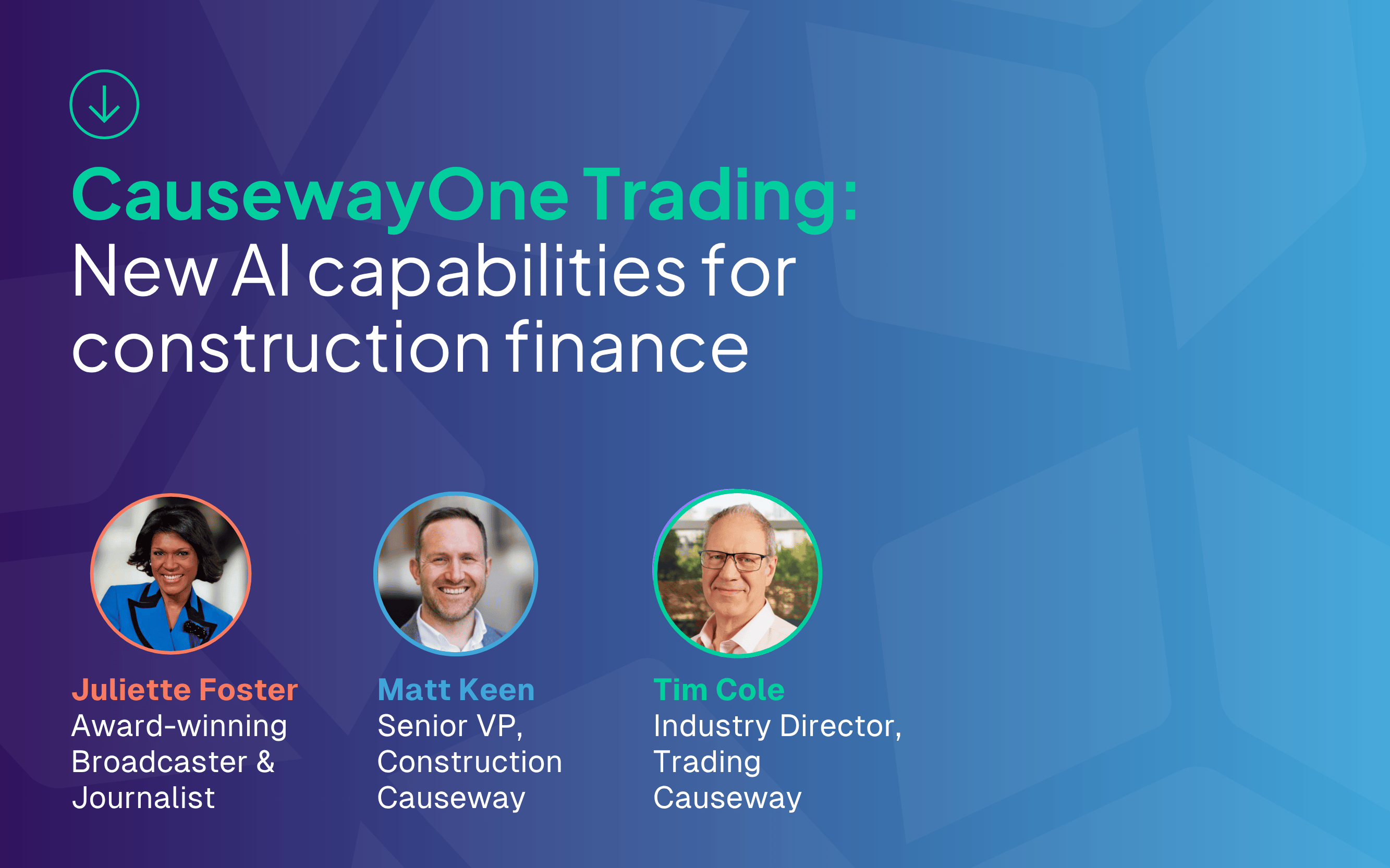
Juliette Foster, Award winning broadcaster and journalist opens 'CausewayOne: New AI capabilities for pre-construction' webinar. Watch the full webinar here.
Is AI already being used in estimating?
Yes, many contractors large and small have already introduced AI into their process but often in a limited way with little means of control and organisational structure.
For example, many estimators are already experimenting with tools such as ChatGPT, Claude and Microsoft Copilot to:
-
Summarise tender documents
-
Draft emails and RFIs
-
Create checklists
-
Review meeting notes
-
Find information more quickly
These tools can save time and improve productivity. However, they are generally helping around the edges of the estimating process rather than inside it.
The bigger opportunity lies in AI that can work directly within pre-construction workflows and alongside an organisation's estimating data.
Will AI replace the estimating role?
Likely not in the short term, but it will change how estimators work.
From the conversations happening across the industry today, most estimating and commercial leaders aren't worried about AI replacing experienced estimators. They're looking for practical ways to use AI to remove administration, reduce repetitive work and improve efficiency without compromising accuracy.
AI isn't going anywhere, but the focus is on finding real-world use cases that improve productivity to help protect margin in an increasingly competitive market.
What will estimators still do that AI can't?
Estimating is still a judgement-driven role.
While AI can help process and analyse information, experienced estimators are still responsible for:
-
Assessing commercial risk
-
Challenging assumptions
-
Reviewing scope
-
Evaluating supplier returns
-
Applying local market knowledge
-
Making pricing decisions
-
Protecting margin
These decisions require context, experience and accountability; all things AI currently struggles with.
Where can AI add value in the estimating process today?
The strongest AI use cases focus on reducing the manual effort surrounding estimating. AI can help remove many of the repetitive tasks that consume an estimator's day, including:
-
Preparing and structuring tender information
-
Managing supplier enquiries
-
Comparing subcontractor returns
-
Retrieving historical project knowledge
Causeway's AI research suggests efficiency gains of up to 75% are possible when AI is embedded into pre-construction workflows. The goal isn't to replace estimators, but to help them spend less time processing information and more time applying commercial judgement, improving visibility, confidence and decision-making throughout the bid process.
How can AI speed up tender preparation and pricing?
AI can help structure and classify tender information, reducing the time spent manually organising data before pricing begins.
It can also analyse tender documents, categorise work packages and draw on historical project data, rate libraries and previous estimates to provide a baseline estimate for review. Rather than starting from a blank spreadsheet, estimators can begin with an estimate that's already significantly progressed, allowing them to focus on validating assumptions, managing risk and refining pricing.
The real value isn't automating the final estimate. It's accelerating the early stages of the process and removing some of the data grunt work so estimators can spend more time applying commercial judgement where it matters most.
How can AI help with enquiries and compare subcontractor returns?
Pre-construction software can already support with streamlining the enquiries process but embedding AI can save on average 4.5 hours per bid. It does this by:
-
Validating package completeness
-
Matching suppliers to work packages
-
Draft enquiry communications
-
Track responses
-
Highlight coverage gaps
- Standardising subcontractor returns for comparison
- Identifying pricing anomalies and outliers
- Flagging inclusions, exclusions and potential risks
This alleviates the biggest frustrations for contractors that subcontract work: managing enquiries, chasing quotes and comparing large volumes of supplier responses. Instead of manually reviewing every return, estimators can focus their attention on commercial decisions, risk and bid quality while AI helps surface the areas that require closer review.
How can AI identify tender risks?
Specialised AI industry agents understand your bid data and can accurately review large sets of documents and surface:
-
Missing information
-
Qualifications
-
Deviations
-
Scope inconsistencies
-
Potential coverage gaps
This helps estimators focus attention where it matters most.
Video caption: Heather Simmonds, Pre-Sales Consultant at Causeway walks through the latest AI tools embedded in CausewayOne Estimating. Watch the full webinar 'CausewayOne: New AI capabilities for pre-construction' here.
How much time can AI save estimators?
Causeway's research suggests AI-enabled workflows could deliver efficiency gains of up to 75% in parts of the bid process.
The key point isn't simply saving time.
Research also found that 77% of estimators would use that additional time to:
-
Fine-tune estimates
-
Review assumptions
-
Manage risk
-
Improve bid quality
Rather than producing more bids, many teams would use AI to produce better bids to improve project margins.
Should I use ChatGPT, Copilot or Claude for estimating?
This is one of the most common questions being asked today.
Generic AI tools are incredibly useful, but they have limitations in estimating environments which result in additional estimating resource checking and auditing AI outputs.
They typically don't have access to:
-
Your rate libraries
-
Historic estimates
-
Supply chain data
-
Commercial rules
-
Previous bid outcomes
-
Company-specific knowledge
They can generate plausible responses, but they don't understand the commercial reality of your business.
This is particularly important when pricing decisions can have significant margin implications.
What are the risks of using generic AI in
pre-construction?
AI in pre-construction needs careful handling because the commercial implications are significant.
Some of the key risks include:
Hallucinations
AI can produce convincing but inaccurate information, presenting assumptions or incorrect outputs as fact. In a pre-construction environment, this could mean misinterpreting tender requirements, inventing missing details or drawing conclusions that aren't supported by the source documents, which is why human review remains essential.
Lack of commercial context
Generic AI doesn't understand your projects, suppliers or historical performance. Poor-quality or inconsistent data leads to weak outputs.
Data security
Many contractors have concerns about sharing commercially sensitive information with AI tools. Even with enterprise-grade platforms, employees can inadvertently upload business-critical data, creating a risk that confidential information is exposed to the wrong users, workspaces, or AI projects.
Lack of auditability
Estimating decisions need to be explainable and defensible. Many AI tools do not provide an audit trial that is easily tracked back which reduces trust in the output.
For this reason, human oversight remains essential wherever AI influences pricing, contractual decisions or commercial risk.
Is AI in construction regulated?
Yes and increasingly so.
AI use in construction estimating and commercial decision-making is shaped by professional guidance and regulation. UK procurement guidance, RICS research and CECA insights all converge on the same principle: AI must be transparent, explainable and governed, particularly where it influences pricing, risk or bid decisions.
For contractors evaluating estimating software this reinforces the importance of platforms that support auditability and human oversight.
Is your data AI-ready?
One of the biggest misconceptions about AI in construction is that it can be layered on top of existing processes and immediately deliver results.
Connected pre-construction technology matters more than AI features.
In reality, AI is only as effective as the data and workflows beneath it. Most contractors now use a mix of digital estimating tools for contractors, spreadsheets and point solutions introduced over time to solve individual problems. The result is often fragmented workflows, duplicated effort and data that is difficult to trust or reuse.
Introducing AI into this environment does not remove complexity - it exposes it. Without connected systems and structured data, AI struggles to deliver meaningful insight and can even amplify existing inefficiencies.
The first step is making data AI-ready
Research referenced in Causeway's AI guide found:
-
57% of organisations believe their data is not AI-ready
-
60% of contractors still rely heavily on spreadsheets
Without connected data, AI can accelerate activity without improving outcomes.
The contractors likely to benefit most from AI are those that first establish:
-
Connected workflows
-
Consistent estimating processes
-
Shared rate structures
-
Reliable data
-
Strong governance
This is why the most important shift happening in pre-construction today is not about smarter algorithms, but about connected pre-construction technology.
When estimating, enquiries, supplier data and documents sit within joined-up pre-construction solutions, several things change:
- Data becomes consistent and reusable
- Teams spend less time chasing information
- Risk is easier to identify earlier in the process
In this context, AI becomes an enabler, rather than a headline feature, embedded into the workflow, governed and reliable.est
Still using spreadsheets for estimating?
You are not alone.
A significant proportion of contractors still rely heavily on spreadsheets for estimating, whilst those who have implemented dedicated estimating software still face issues with disconnected systems where systems don't speak to each other. For those teams, AI can feel distant or unrealistic amid day-to-day pressures and tender deadlines.
The key point is this: the first step is not adopting AI.
The first step is reducing fragmentation across the whole pre-construction process. Improving data structure, connecting workflows and creating a clearer flow of information.
Once those foundations are in place, AI becomes far more relevant and the potential much more powerful.
What should pre-construction leaders do now?
Contractors actively engaged in rolling out AI strategies today are focusing on three areas:
1. Create a connected pre-construction environment
AI is only as effective as the information it can access. Many pre-construction teams still rely on spreadsheets, email-driven workflows and disconnected systems, making it difficult for information to flow between estimating, enquiries, supplier management and commercial teams.
Creating a connected environment allows project history, rate libraries, supplier information and bid data to work together, giving AI the context it needs to deliver reliable outputs. Without this foundation, AI risks accelerating the movement of information without improving its quality.
2. Establish governance and security
Where AI influences pricing, risk or commercial decisions, organisations need confidence in both the quality of the data and the outputs being generated.
This means putting clear controls in place around:
-
Data access and security
-
Human review and approval
-
Auditability and traceability
-
Accountability for commercial decisions
AI should support decision-making, not replace it. Human oversight remains essential, particularly where pricing, risk or contractual obligations are involved.
3. Focus on practical use cases
The contractors seeing the greatest value aren't trying to automate the entire estimating process overnight. Instead, they're targeting areas where estimators spend the most time on repetitive, low-value administration.
These activities consume significant time but often add limited commercial value. By reducing administrative effort, AI gives estimators more time to focus on pricing, risk management, value engineering and bid quality.
Start with the foundations
The firms most likely to benefit from AI are not necessarily those using the most AI tools. They're the organisations building towards connected data, standardised processes and secure workflows that allow AI to be applied effectively across the bidding process. AI is becoming a competitive advantage, but only when it's supported by the right foundations.
The good news is contractors don't need to tackle this challenge alone. Industry technology providers like Causeway, have already invested heavily in building a platform that embeds AI into pre-construction workflows, connecting data and building the governance frameworks required for safe valuable adoption.
The future of AI in estimating
The future of estimating isn't AI-generated bids with humans removed from the process. It's AI-enabled estimators with faster access to information, stronger insights and more time to focus on commercial decision-making.
As AI becomes embedded within pre-construction workflows, it will increasingly take on repetitive tasks such as processing tender information, retrieving historical project data, managing enquiries and analysing subcontractor returns. This will allow estimators to spend more time on pricing strategy, risk assessment, value engineering and bid quality, where their expertise adds the greatest value.
The biggest differentiator won't be which AI tool a contractor uses. It will be the quality and connectivity of the data behind it. Contractors that create connected pre-construction environments, with access to project history, rate libraries, supplier data and commercial knowledge, will be best positioned to unlock the full value of AI.
Ultimately, AI won't replace estimator judgement. It will amplify it. The firms that gain the greatest advantage will be those that combine experienced people, connected data and AI-driven workflows to produce faster, more informed and more confident bids.
How does CausewayOne
Pre-Construction use AI?
The real value of AI in pre-construction comes when it's embedded directly into the estimating workflow, rather than sitting in a separate tool.
CausewayOne Pre-Construction brings together estimating, enquiries, supplier management and project data in a connected environment, enabling AI to understand not just individual pieces of information, but the relationships between them. This gives AI the context it needs to support estimating workflows more effectively than generic tools operating in isolation.
As a result, pre-construction teams can use AI to automate repetitive tasks, uncover insights from historical and live project data, and reduce the administrative burden that often sits around the estimating process. The outcome is a faster, more connected bidding workflow that allows estimators to focus on commercial judgement, risk and bid quality.
Examples of how AI can support pre-construction teams include:
-
Converting tender documents and BOQs into structured estimating data
-
Automating elements of estimate and package preparation
-
Matching suppliers to relevant work packages
-
Supporting enquiry management and follow-up activities
-
Highlighting gaps, risks and anomalies within subcontractor returns
-
Retrieving relevant information from previous bids and projects
-
Helping teams identify opportunities to improve consistency and reduce manual effort
As AI capabilities evolve, connected platforms such as CausewayOne Pre-Construction will play an increasingly important role by combining company knowledge, historical project data and estimating workflows in a secure, governed environment.
Video caption: Matt Keen, Senior VP Construction at Causeway explains how CausewayOne AI was developed and how they addressed key industry challenges. Watch the full webinar 'CausewayOne: New AI capabilities for pre-construction' here.
A practical guide to AI in
pre-construction
To help contractors navigate this moment, we’ve created a new ebook:
AI is redefining pre-construction. Here's how.
Written for estimators, commercial leaders and digital decision-makers, the guide focuses on clarity over hype. It explores:
-
What AI can – and can’t – realistically do in construction estimating
-
Why connected systems matter more than automation alone
-
What AI makes possible at every stage of the bid
-
What modern pre-construction technology makes possible
-
Practical steps to prepare without disrupting delivery
If you are exploring estimating software for construction, or trying to understand where AI fits into your estimating process, the guide is designed to help you make informed decisions.
👉 Download the ebook: AI is redefining pre-construction. Here's how.
Artificial Intelligence (AI) in construction estimating uses technology to help contractors process information, automate repetitive tasks and support decision-making throughout the bidding process.
The greatest value comes when AI operates within a connected pre-construction data environment, giving it access to estimating data, supplier information, project history and enquiries. This provides the context needed to improve efficiency, surface insights and support more confident bidding decisions, while leaving commercial judgement in the hands of estimators.
Research highlighted in Causeway's 'AI is redefining pre-construction' guide suggests efficiency gains of up to 75% across estimating and enquiries workflows, enabling teams to spend less time on administration and more time on value-adding activities such as pricing, risk assessment, supplier engagement and bid strategy.
- BOQ imports
- Pricing support
- Document review
- Information retrieval
- Subcontractor quote comparison
General-purpose AI tools can be useful for research, drafting content and reviewing documents. However, they typically don't have access to your company's rate libraries, historical estimates, supplier data or commercial rules.
For this reason, they should be treated as productivity tools rather than estimating tools, with all outputs reviewed by an experienced professional.
AI depends on reliable, connected information in order to deliver valuable insight. Without this continuity, AI tools are forced to work in isolation and their impact remains limited.
For pre-construction and estimating this means bid data, assumptions and supplier need to be connected and structured. If inputs are fragmented, outputs become less dependable.
AI needs clean, connected and structured data to deliver value. Poor data quality, weak governance, lack of transparency and over-reliance on automation in sensitive commercial decisions can impact accuracy and increase risk.
Other risks include:
- Inaccurate or fabricated information (hallucinations)
- Lack of commercial context
- Poor quality or incomplete data
- Security concerns around sensitive company information
- Limited auditability and accountability
The most successful AI projects start with strong foundations. Pre-construction and estimating leaders should start by:
- Connect estimating and enquiry workflows
- Clean and structure data to create a connected data environment
- Standardise processes
- Define clear governance and security controls
- Test practical use cases focused on reducing manual effort



.png?width=2666&height=1665&name=PRECON%20AI%20webinar%20-%20OnDemand%20Feature%20Image%20(2).png)