The Department for Transport (DfT) has shared its latest update on Digital Traffic Regulation Orders (D-TRO). Every traffic authority will receive £37,000 to support the move to D-TRO. The legal requirement to submit new TROs and TTROs digitally is expected to start in 2027, with at least 12 weeks' notice.
The update came in DfT's webinar on 24 September 2026 marking one year of the service in public beta. Details may change as DfT publishes further guidance.
For authorities, it's welcome news. The funding is fair, the timeline is clearer, and early movers aren't penalised. For most of our customers, it also changes very little day to day, as they're already D-TRO compliant and submitting their orders. The real gap is between authorities that are ready and those that aren't, and 12 weeks' notice won't close it for anyone starting from scratch.
Here's what was announced, and what it means for highways and traffic management teams.
Key takeaways
- Each authority will receive a one-off, flat payment of £37,000, around £5.9 million in total
- Most authorities outside London should receive the money in mid-October 2026
- DfT expects the D-TRO legal requirement to come into force after February 2027
- Authorities have been promised at least 12 weeks' notice before the start date
- Digitising historic TROs is not currently required
What did DfT announce about D-TRO funding?
DfT confirmed long-awaited "new burdens" one-off flat payment of £37,000 per local authority. It is based on the cost of one year of D-TRO software licensing. The figure was worked out with the Local Government Association and JAG UK.
It said the same amount will be available to every authority, regardless of size or whether it has already invested in a software solution. In total, this represents around £5.9 million of funding for the sector.
The money is not ring-fenced for D-TRO. That gives authorities flexibility, but it also means traffic teams may need to make the case internally for how it is used.
That's an important distinction for authorities that have already started preparing. Investing early does not exclude you from the funding.
When and how will councils receive the money?
For most authorities outside London, the payment is due in mid-October 2026.
Some authorities will receive it through a regional transport fund rather than directly. DfT advised traffic managers to speak to their finance teams now so they can identify and claim the funding. DfT will write to each authority, which must confirm the right recipient before payment is made.
London boroughs and those within a mayoral authority will receive the funding via their regional body. The timeline is expected to be similar.
When will D-TRO become a legal requirement?
DfT has not yet announced a fixed date.
However, the webinar gave authorities a clearer indication of the expected timetable. DfT said it is continuing to progress the statutory instrument that would mandate D-TRO use by traffic authorities. Subject to the remaining clearance and parliamentary processes, it expects the requirements to come into force in the new year, after February 2027.
DfT also reconfirmed that authorities will receive a minimum of 12 weeks' notice before the requirements come into force.
That doesn't make March 2027 a deadline. Parliamentary processes can affect the timetable, and it deliberately stopped short of giving a fixed commencement date.
But it does give authorities a clearer planning window.
What will councils need to publish?
The direction remains the same: DfT intends to require traffic authorities in England to submit to them information about new TROs in a standardised format. DfT will then make this available as open digital data.
Do authorities need to digitise historic TROs?
Not at the moment.
DfT said it is not currently asking authorities to digitise their historic TRO records as part of the new requirement, and the £37,000 funding does not cover it. Instead, it is exploring how to handle historic orders in two initiatives:
First, it has sent a questionnaire to local authorities to better understand how many historic, active TROs are held across England. If your authority has received it, DfT is asking authorities to complete it as soon as possible, as the answers will help shape its next steps.
Separately, DfT has issued a request for information (RFI) to explore a potential scan of every street in England. The idea is to create a baseline of traffic signs, road markings and other road data that could help authorities digitise active historic orders.
The work is at an early stage and DfT was clear that the RFI is not a procurement exercise, and questions around how the data would be collected and used remain open.
How is the D-TRO service progressing?
The announcement comes one year after the D-TRO service moved into public beta.
DfT reported growing use across publishers, digital solution providers and data consumers during that first year. There are now nearly 600 registered applications, and the service is on track to pass 1.2 million API calls during September 2026.
Most orders published so far are temporary traffic regulation orders (TTROs), which reflects how many TTROs councils create each year.
DfT also shared plans for version 5 of the data specification, due in production at the end of November, with the main change bringing speed limits in line with other regulation types. Alongside this, a new online user portal has launched, with a searchable knowledge base and a way to raise support cases.
The D-TRO update is here. Now it's time to move
We welcome DfT's update. It gives highway authorities more certainty about both funding and timing, and that certainty creates a clearer window to prepare.
A flat payment is a fair approach. Authorities that have already invested in D-TRO readiness won't be penalised for moving early, while every authority has funding to support the work still to come.
The timeline matters just as much. 12 weeks' formal notice is not long to change processes, train teams and test publishing. Our view is that authorities should treat the months ahead as their planning window, rather than wait for that notice to arrive.
TTROs should be a particular focus. They make up the majority of new orders, so authorities still relying on slow or manual TTRO processes are likely to feel the demands of D-TRO most.
D-TRO readiness is about more than meeting the requirement. Accurate, digital traffic order data can help authorities manage their networks, coordinate works and give road users better information. The opportunity is to use D-TRO to improve the process, not just comply with it.
"Most of the authorities we work with are already D-TRO compliant, and this update confirms they made the right call. For everyone else, the months ahead are the time to plan, not to wait for notice."
Nick Smee, Senior Vice President, Highways, Causeway Technologies
What should authorities do next?
With funding confirmed and a start date in sight, now is the time to act. For highway authorities, that means five practical things:
- Talk to finance. Confirm where the £37,000 will reach you and agree how it will be used.
- Check your software. Make sure your TRO and TTRO processes can create and publish D-TRO data.
- Look at TTROs first. They make up most new orders, so a smooth digital TTRO process will carry most of the load.
- Complete DfT questionnaire on 'active' historic orders if you've received it.
- Plan for the 12-week window. Don't wait for the notice to start preparing.
How Causeway supports D-TRO
DfT's latest update gives you something they've been waiting for: more certainty.
With confirmed funding, a clearer timeline and at least 12 weeks' notice before the requirement takes effect, you now have more information to plan your next steps and keep your D-TRO preparations moving.
Causeway has a roadmap to support you through both stages of D-TRO: getting ready now and becoming compliant later.
Get D-TRO ready: start with new orders
From 2027, all new TROs and TTROs must be D-TRO compliant. Our integrated offer covers both types of order:
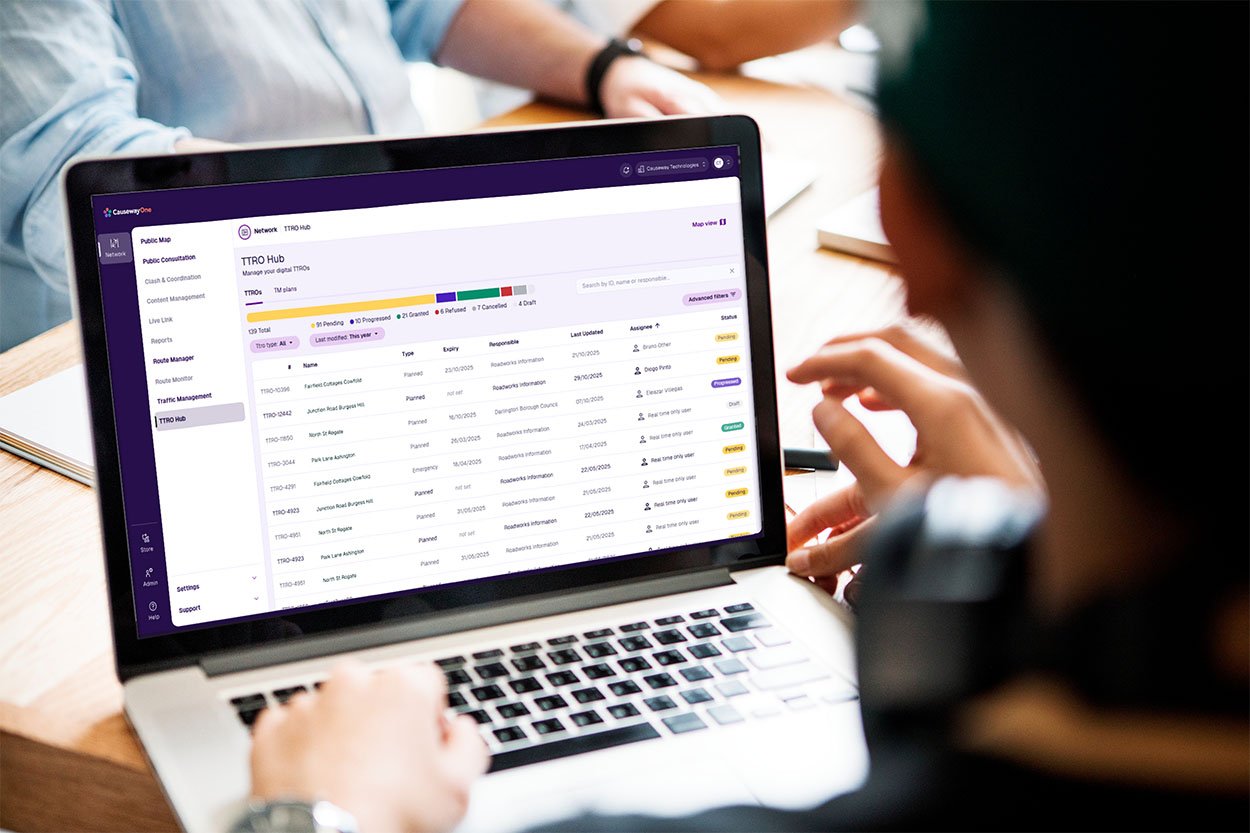
- CausewayOne Network for digital TTRO management, already used by more than 100 highway authorities
- Causeway ParkMap for permanent TROs, trusted by over 90 authorities
Be D-TRO compliant: active historic orders
The next stage is bringing your active historic orders into the service. DfT has not yet set a requirement or timeline for this yet, but it's where D-TRO is heading. Our consultancy team already helps councils survey digitise, and manage their existing orders, so you're prepared when the time comes.
Councils using CausewayOne Network are already seeing results. Cambridgeshire County Council approves TTROs 31 times faster and Wiltshire Council saves 97 working days a year.
Find out how Causeway can support your D-TRO journey
FAQs
What is D-TRO?
D-TRO (Digital Traffic Regulation Orders) is a DfT service that requires traffic authorities to submit TRO and TTRO data in a standard digital format to a central, open database.
How much D-TRO funding will councils get?
DfT is providing a one-off payment of £37,000 per local authority, totalling £5.9 million sector-wide, to help cover a year of software licensing costs.
Most authorities outside London should receive it around mid-October; London authorities and those within a mayoral authority will receive it from via the regional body.
When does D-TRO become mandatory?
DfT expects the legal requirement to start after February 2027, with at least 12 weeks' notice.
Can authorities publish D-TROs before they become mandatory?
Yes. The D-TRO service has been in public beta since September 2025, and authorities are already publishing orders through it, either directly or through a software provider. DfT is encouraging councils to start before the legal requirement comes in.
Speak to us about getting started.
Is D-TRO funding ring-fenced?
No. DfT confirmed it is not ring-fenced but it is intended to support D-TRO.
Do councils have to digitise historic TROs?
Not currently. DfT is exploring other options, including a national street scan.
If improving your historic TRO data is already part of your plans, see how we can support.
Does D-TRO apply to TTROs?
Yes. Both permanent TROs and TTROs are covered, and TTROs make up most new orders.
How can Causeway help with D-TRO?
Causeway supports both types of order: CausewayOne Network for digital TTRO management and Causeway ParkMap for permanent TROs, with consultancy support for data projects. Talk to our D-TRO experts.