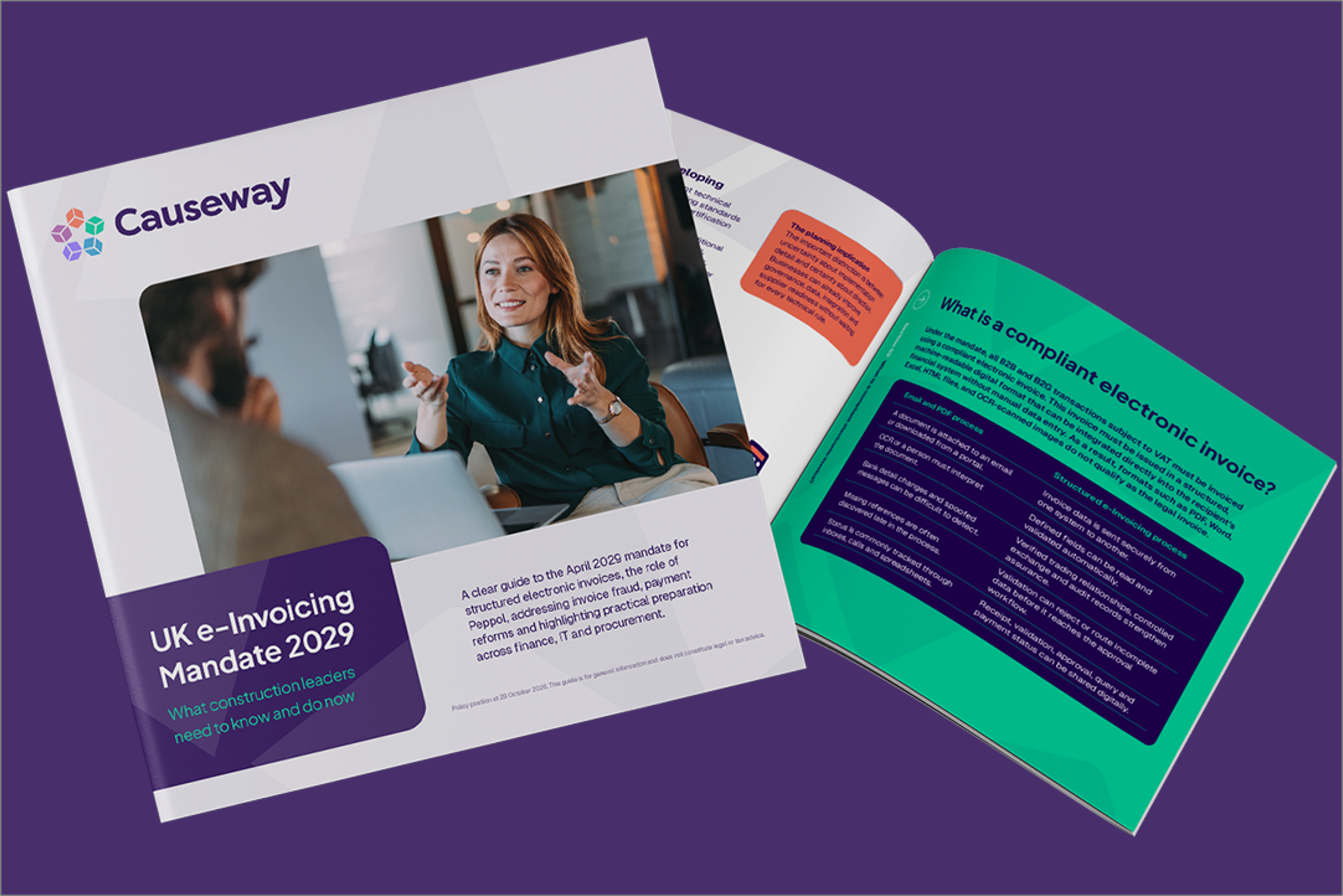
The UK Government has published its latest update on the roadmap for e-Invoicing implementation, providing the clearest view yet of how the move towards mandatory e-Invoicing will take shape ahead of April 2029.
For construction businesses, this is an important step forward. The date itself has not changed, but the roadmap adds detail around who will be affected, what counts as a compliant e-Invoice and when the remaining rules and technical standards will be confirmed.
The direction is now clear. From 1 April 2029, VAT-registered organisations will need to be able to exchange compliant e-Invoices where a VAT invoice is required, unless a specific exemption applies.
For an industry managing high invoice volumes, complex supply chains and project-specific commercial data, the message is simple: the time to understand your current position is now.
Which roadmap milestones lead to April 2029?
The Government first confirmed the April 2029 mandate at Budget 2025. It has since confirmed that Peppol will form the core interoperability framework for UK e-Invoicing.
The new roadmap builds on that direction by setting out a phased delivery plan and the milestones businesses should expect between now and implementation. The key milestones include:
-
Spring 2027: a public technical consultation on the proposed UK e-Invoicing standards and Access Point certification requirements.
-
By the end of 2027: further guidance on specific rules and exemptions, including support for digitally excluded organisations.
-
Between October 2027 and April 2028: publication of the final requirements, including standards, business identifiers, taxpayer obligations and software-provider requirements.
-
By April 2028: updated VAT guidance and details of how exemptions will operate.
-
1 April 2029: the e-Invoicing requirements take effect.
The Government has committed to giving businesses and software providers at least 12 months’ notice of the final requirements. It does not currently plan to make further changes after April 2028, unless necessary following stakeholder feedback.
That gives the market a firmer planning window. But it should not be mistaken for a reason to wait. The businesses that start early will have more time to improve their data, engage suppliers and incorporate e-Invoicing into wider finance, procurement and digital transformation programmes.
What counts as an e-Invoice?
One of the roadmap’s most useful clarifications is its definition of e-Invoicing.
An e-Invoice is not simply an invoice sent electronically. It is the exchange of structured invoice data directly between buyers’ and suppliers’ finance systems.
That means these formats will not meet the future definition of an e-Invoice, even though they may be sent digitally today:
-
Emailed PDFs
-
Word documents
-
Images
-
Web-page invoices
-
Scanned paperwork
The difference matters.
A PDF can be read by a person, but HMRC does not accept this as reliably giving finance systems the structured information they need to validate, match and process an invoice automatically. Structured data enables systems to recognise key information consistently, including supplier details, purchase order numbers, invoice lines, tax values and delivery references.
An invoice sending process may extract information from a PDF to generate a compliant e-Invoice. However, the PDF itself remains an unstructured document and will not be accepted as the legal invoice exchanged under the mandate.
For construction, this creates the foundation for more reliable matching between invoices, purchase orders, goods received notes and project records. It can reduce re-keying, improve visibility of invoice status and help teams identify and resolve exceptions earlier.
Who must send and receive e-Invoices from April 2029?
The requirements are intended to apply broadly to VAT-registered organisations, including businesses, sole traders, charities and public sector bodies.
In practice, from April 2029, a VAT-registered organisation will need to issue an e-Invoice when making a taxable supply to another VAT-registered organisation in the UK. It will also need to be capable of receiving e-Invoices.
The roadmap confirms that the requirements will not apply to:
-
Sales to end consumers, where a VAT invoice is not required.
-
Cross-border transactions.
-
Organisations that are not VAT registered, although they may choose to use e-Invoicing voluntarily.
-
Digitally excluded or otherwise exempt organisations, subject to the final rules.
The Government has indicated that exemptions will be tightly defined. It intends to follow a similar approach to Making Tax Digital for VAT, recognising that some organisations may not reasonably be able to use computers, software or the internet.
For most construction businesses, however, the mandate will reach across both sides of the invoice process. Buyers will need to receive and process compliant e-Invoices, while suppliers and subcontractors will need to create and send them.
Peppol provides the common framework
Peppol is an international interoperability framework that defines the rules and standards for the secure and compliant exchange of standardised business documents. It provides the common framework that enables compliant invoice data exchange between different systems and service providers.
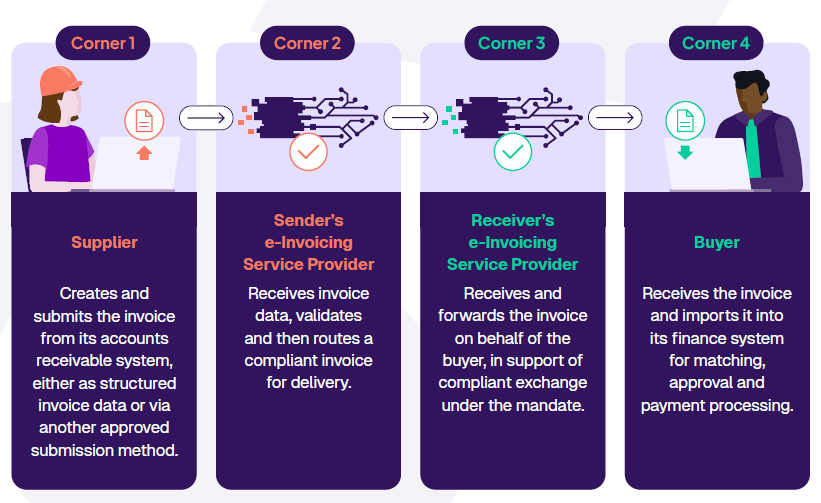
This is particularly relevant to construction, where a single contractor or housebuilder may work with thousands of suppliers, subcontractors, merchants and service providers using different finance systems.
The goal is to create a common way for systems to exchange structured invoice data, reducing the need for bespoke connections between every trading relationship.
Businesses will generally connect using a certified Peppol Access Point, typically through an e-Invoicing service provider. The technical setup and certification process will primarily sit with these providers, but businesses should still understand how their chosen systems will support the mandate requirements.
The roadmap also recognises that established arrangements remain an important part of many organisations' operations. While these arrangements may continue, organisations will still need to be capable of exchanging e-Invoices with all buyers and suppliers. This is particularly important for construction firms operating complex ERP environments, multiple trading divisions or established supplier networks.
Five details the Government has yet to confirm
While the roadmap provides much greater clarity, several important details remain subject to consultation and final confirmation.
The Government will consult on the technical standards in Spring 2027 before publishing the final requirements between October 2027 and April 2028. This includes decisions around:
-
The detailed UK data standards and any UK-specific Peppol requirements.
-
The business identifiers organisations will use to send and receive compliant e-Invoices.
-
Software-provider obligations and assurance arrangements.
-
The final exemption process.
-
Guidance on how existing systems and processes will operate under the mandate.
The Government has also opened an exploratory consultation into whether e-Invoicing data could support future digital reporting directly into HMRC. Crucially, no decision has been made to introduce a new tax authority reporting requirement. Businesses should not confuse this consultation with the April 2029 mandate itself.
Structured data cuts friction across construction finance
The mandate is not simply about changing the format of an invoice. Construction finance teams often manage fragmented processes across projects, regions, suppliers and systems.
Invoices can be delayed by:
-
Missing purchase order references
-
Unconfirmed deliveries
-
Unclear project coding
-
Manual approval steps
-
Each exception adds cost, time and friction for both buyer and supplier.
Structured e-Invoicing gives organisations a stronger basis for improving those processes. It can also support:
-
More accurate invoice matching and validation.
-
Fewer manual touchpoints across Accounts Payable and Accounts Receivable.
- Better visibility of invoice receipt, approval and payment status.
- Better-quality data for forecasting and reporting.
- More consistent collaboration between finance, procurement, commercial and site teams.
- Greater transparency across trading relationships and the wider supply chain.
- Simpler and clearer access to business insights for buyers and suppliers.
It also has an important role to play in the wider push for fairer payment. E-Invoicing cannot make a business pay more quickly on its own, but it can remove many of the avoidable delays and disputes that slow payment down.
Ask 6 questions to check your readiness
With the final technical details still to come, the right approach is to prepare for the direction of travel rather than wait for every answer.
Finance, procurement and IT leaders should begin by asking a few practical questions:
-
How many invoices do we currently receive as paper, PDF, portal submissions, EDI files or structured data?
-
Where are the biggest manual touchpoints, delays and recurring exceptions?
-
Are purchase order, delivery, project, product, and supplier references consistently captured and accurate?
-
Can our existing systems import, export and retain structured invoice data?
-
How will we support suppliers and subcontractors with different levels of digital capability?
-
Who owns business readiness across finance, procurement, IT and operations?
The most successful programmes will treat e-Invoicing as more than a compliance task. They will use the mandate as an opportunity to strengthen invoice processes, improve supplier relationships and create a more connected flow of structured commercial data, visibility and business insight across the organisation.
Preparing for 2029 – and the opportunity beyond it
The publication of the roadmap is a significant milestone. The April 2029 deadline is now supported by a clearer implementation plan, a defined standards consultation and a commitment to give organisations time to prepare.
For construction, the opportunity is larger than compliance. The transition to structured e-Invoicing can help businesses reduce invoice friction today while laying stronger foundations for automation, visibility and fairer payment in the years ahead.
Explore Causeway’s e-Invoicing mandate resourcesExplore Causeway’s e-Invoicing mandate resources to understand how the upcoming changes could affect your business, or speak to our team about preparing your invoice processes ahead of 2029 and beyond.