
Over the first few posts in this series, we've covered why construction finance is at a turning point, where AI adds real value against fraud and compliance risk, and why generic AI tools fall short of what AP and AR teams actually need. So, the natural next question is: what do you actually do about it?
The good news is that benefiting from AI doesn't require huge upfront investment or a full business transformation from day one. Contractors and suppliers can prepare for what's coming by taking three practical steps.
1. Join a digital trading environment for AI-ready data
Many finance teams still rely on a mix of systems, spreadsheets, PDFs and email-driven queries. It's familiar, but it fragments data and makes consistency, traceability and control genuinely difficult.
Moving to a digitally connected trading environment is the practical first step. Shared structures, clean trading-partner data and controlled compliance rules create a stable foundation that AI can operate on with confidence.
Just as important is making your data AI-ready. That means building a golden thread of information that flows across POs, GRNs, invoices, approvals, payments and statements, so insight builds up over time instead of resetting at every stage. Without that continuity, AI tools end up working in isolation, and their impact stays limited.
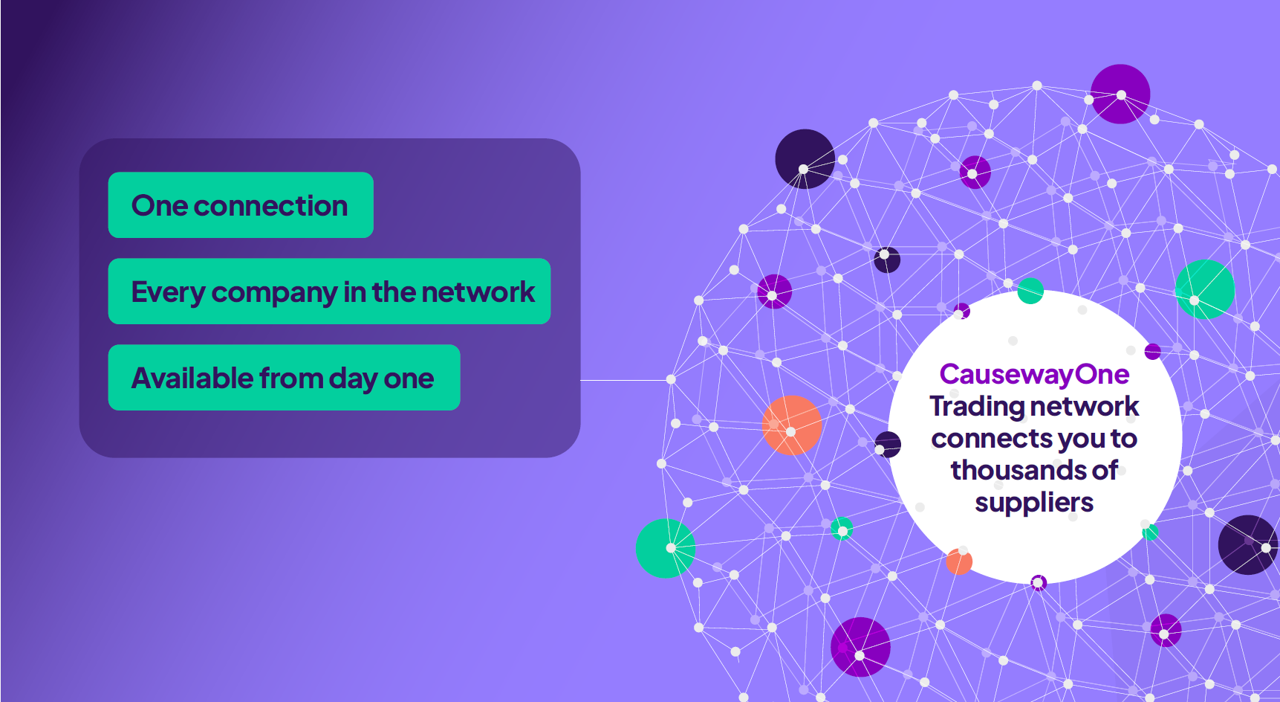
Here's the thing for teams starting from scratch: every delay sets back both readiness and efficiency gains, and it limits the data available to make better decisions. Joining an existing network changes that equation. Connect into a community of thousands of companies, and adoption speeds up straight away. Value arrives faster, and the intelligence AI draws on grows with every transaction from day one, a compounding advantage that starting from zero simply can't replicate.
Think of it like moving into a neighbourhood that's already built up, with roads, utilities and neighbours in place, rather than being handed an empty field and asked to build the whole community yourself. One gets you real value on day one. The other could take years to deliver anything at all.
2. Get AI governance and security right
Wherever AI influences payment, compliance or contractual decisions, your organisation needs confidence in three things:
-
The quality of the data
-
The security of the environment
-
The ability to audit and validate every output
This isn't just good practice. UK procurement guidance and CECA both stress the importance of human oversight and control wherever AI supports commercial decisions. AI-enabled trading platforms can help address this by design, giving finance teams a more secure, governed way to put AI to work in practice, rather than bolting on a tool and hoping for the best.
In practical terms, that means being able to answer a simple question with confidence: if a regulator or auditor asked why a payment was approved or an invoice was rejected, could you show your working? With the right platform, the answer is yes, every time.
Watch our full OnDemand webinar here.
3. Choose specialist AI platforms over generic tools
General-purpose AI can support isolated tasks well. But generic tools can't see your live PO data, matching history or payment patterns - the greatest commercial value comes from specialist platforms that embed AI directly within day-to-day AP and AR workflows.
The businesses most likely to benefit are the ones preparing now, connecting their data, improving process continuity, and adopting tools built for the realities of construction trading rather than retrofitted from generic AI products.
Why act now on the 2029 e-Invoicing mandate?
None of this needs to happen overnight, but it does need to start. With the 2029 e-Invoicing mandate approaching, fraud risk climbing and fair payment rules tightening, the businesses that move early will be the ones best placed to gain a real advantage: paying suppliers faster and more accurately, collecting from customers with greater confidence, and reducing risk on both sides of every trade.
 There's also a practical reason not to wait. Networks take time to build. A platform that already connects thousands of companies gives you a head start that's very hard to replicate by starting from an empty room and building your own community from scratch. The earlier you connect, the sooner that advantage starts compounding in your favour.
Why should these three steps be considered together?
Taken together, these three steps aren't about chasing the latest AI trend. They're about building the foundations that make AI genuinely useful: connected data, proper governance, and tools designed for how construction actually trades.
In the final post in this series, we'll take a closer look at CausewayOne Trading itself: how it brings these three steps together in practice, what the AP and AR journeys actually look like day-to-day, and what makes the network beneath it so hard for anyone to replicate.
At Causeway, we help construction finance teams take these steps with confidence. Get in touch to find out how CausewayOne can support your finance transformation.




.png?width=2666&height=1665&name=CONS_Future%20of%20Construction%20Payments%20Webinar_Feature%20Image%20(1).png)