
We have already looked at why construction finance is at a turning point, and how AI helps tackle the fraud, risk and compliance pressures piling up on AP and AR teams. So it's a fair question to ask: could a tool like ChatGPT or Copilot just handle this?
Many finance teams are already experimenting with generic AI. In our recent webinar, we asked our audience “where does most of your AI usage come from?” and 77% of attendees shared that it was from general-purpose AI tools. And in the right context, that makes total sense - drafting a supplier email; summarising a long thread; sense-checking a reconciliation approach; helping put together a dispute response. These are practical, everyday applications that can make AP and AR teams more productive without changing the way they work.
But this isn't where the real commercial impact materialises. To deliver meaningful savings and genuine risk reduction across the trading process, AI needs to sit inside the workflow itself, not alongside it.
Are generic AI tools suitable for construction finance?
General-purpose AI and LLMs are built to respond to patterns. They're not built to know your business. They don't have access to your finance systems, your supplier or customer master data, your approval hierarchies, your matching rules, your compliance obligations or your payment history. They respond to what sounds plausible, not what's actually true for your trade.
You can catch up with the full OnDemand webinar here.
Used alone, that gap can introduce more risk than it solves, in a few specific ways:
- They guess where real context is missing. External tools have no access to live PO, GRN, invoicing or payment data, no view of contractual terms, and no awareness of customer-specific submission rules, or which supplier counts as small under the Fair Payment Code.
- They ignore compliance methodology. VAT rules, CIS, Domestic Reverse Charge, fair payment thresholds and the 2029 e-Invoicing mandate all carry specific, sometimes shifting obligations. Generic tools simply don't track them.
- They can sound confident while producing errors. Confident language can mask weak logic, missing context or inaccurate numbers, and in finance, that risk carries a real cost on both sides of the trade.
- They offer limited auditability. There's no clear logic chain, no defensible method, and no governance around how outputs get approved. Auditors and regulators need more than that.
- They can expose commercially sensitive data. Free public models come with little governance or security. Invoice data, supplier and customer records and payment information shouldn't pass through them at all.
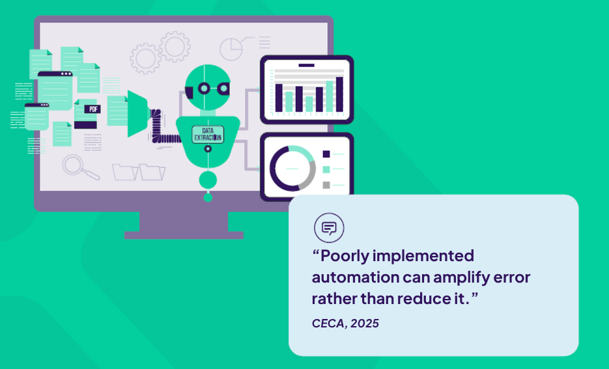
As CECA's Artificial Intelligence in UK Construction report puts it plainly: "poorly implemented automation can amplify error rather than reduce it." The same report stresses the importance of human oversight wherever AI touches financial, contractual or compliance decisions. These aren't edge cases. In construction, a small error can mean a duplicate payment, a fraudulent invoice getting paid, a rejected submission, or a late-payment penalty against fair payment targets.
What can embedded AI do differently for finance teams?
The alternative isn't to avoid AI. It's to embed it properly, within a specialist trading platform that already holds the right data, controls and commercial context.
When AI has access to structured invoice and PO data, matching history, payment status, supplier and customer trading patterns and live compliance rules, what it can do changes completely, and so does how much you can trust what it produces.
Instead of generating a plausible-sounding answer based on patterns alone, embedded AI can:
-
Validate three-way matches with auditable logic
-
Flag anomalies against historic trading patterns before a payment is released
-
Spot suspicious document changes the moment an invoice is received, not after the money's already gone
-
Draft supplier and customer communications using accurate, real-time status information
-
Trigger controlled agents that act on a finance team's behalf within clearly defined guardrails, handling straightforward cases without anyone needing to step in manually
Why do disconnected AI tools increase security risk?
By contrast, AI tools sitting outside the core trading process bring familiar problems. Teams have to step out into separate applications, rebuild context by hand, and move sensitive financial data across systems with limited governance. That increases both security risk and the chance of getting it wrong.
Specialist platforms address this directly. They let AP and AR teams use AI in ways that are genuinely productive and closely aligned to their everyday work, while still providing the mechanisms to audit, cross-check and validate every output, all without commercially sensitive data ever leaving their own environment.
Conclusion: Why construction finance teams shouldn't rely on generic AI tools like ChatGPT or Copilot
Generic AI has its place, and it's a helpful one. But construction trading runs on live data, shifting compliance rules and real money moving between real businesses. That's not a job for a tool guessing at patterns. It's a job for AI that's embedded in the workflow, grounded in your actual data, and built with the guardrails finance decisions deserve.
In the next post, we'll look at three practical steps finance leaders can take right now to get ready for AI-enabled trading, without needing a huge upfront investment or a full business transformation on day one.
At Causeway, we help construction finance teams put AI to work safely, inside the processes that matter. Get in touch to see how CausewayOne validates invoices with auditable logic, not guesswork.


.png?width=2666&height=1665&name=CONS_Future%20of%20Construction%20Payments%20Webinar_Feature%20Image%20(1).png)