For drainage designers, one of the most discussed requirements in the National Standards for Sustainable Drainage Systems (SuDS) is deceptively simple: for the majority of rainfall events, the first 5 mm of rainfall should not result in runoff from the site to surface waters or piped drainage systems.
The requirement sits within Standard 2 – management of everyday rainfall (interception). For Flow users, the key question is not simply whether the drainage system can temporarily store 5 mm of rainfall, but what ultimately happens to that water.
It is an interception requirement, not attenuation
The most important point to grasp is that Standard 2 is not another hydraulic design storm. It asks that the first 5 mm from most events does not generate runoff to surface waters or piped drainage systems, and it sets a seasonal performance expectation: 80% of events intercepted in summer (May to October) and 50% in winter (November to April).
This is sometimes described as managing the "first flush", because early runoff from impermeable surfaces can carry a relatively high pollutant load. But the standard takes a broader view. Standard 2 requires that everyday-rainfall management is developed alongside and in support of water quality (Standard 4) and amenity and biodiversity (Standards 5 and 6).
The practical question is therefore: can the SuDS system stop the initial rainfall simply passing through the development and discharging downstream?
Crucially, interception is not the same as attenuation. The standard is concerned with where the water goes: it should be collected for use, infiltrated, or captured within SuDS features where it is absorbed or lost to soil or the atmosphere rather than discharged. Providing 5 mm of temporary storage that then empties into the sewer does not, on its own, satisfy Standard 2.
A drainage system does not satisfy the interception requirement simply because it can temporarily store the first 5mm; what matters is what ultimately happens to that water.
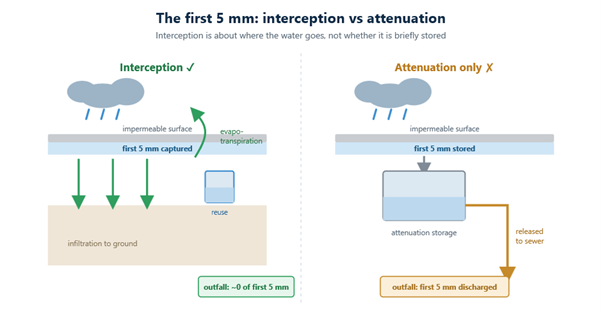
Interception (left) prevents the first 5 mm from discharging off-site; attenuation alone (right) only delays it.
What 5 mm means in practice
At its simplest, 5 mm of rainfall is equivalent to 5 litres per square metre, or 50 m³ per hectare.
So 2,000 m² of positively drained impermeable surface receiving 5 mm represents a gross rainfall volume of:
2,000 × 0.005 = 10 m³
That does not mean the designer simply drops in a 10 m³ tank. What matters is what happens to that water — whether it is genuinely intercepted, or merely delayed on its way to the outfall.
A worked example
Suppose a 2,000 m² impermeable catchment drains to a permeable pavement. The first 5 mm represents 10 m³ of rainfall. The designer must then demonstrate not simply that 10 m³ can be stored, but that the pavement has sufficient effective interception capacity and that the captured water can subsequently be infiltrated, evaporated or otherwise removed from the drainage system rather than discharged to the outfall.
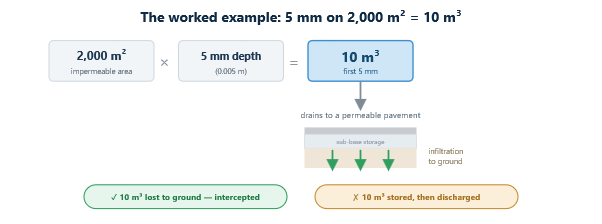
For a simple arrangement like this, that evidence may come largely from volume calculations. For a more complex system — several catchments, multiple SuDS features, or downstream interception — hydraulic modelling can provide the additional evidence.
Which SuDS features can provide interception
The standard sets out several routes that are treated as delivering interception when the stated conditions are met. These include green roofs and walls, rainwater harvesting, soakaways and infiltration systems, permeable surfaces, swales, infiltration trenches, detention basins, and bioretention areas and rain gardens.
|
SuDS feature |
How it can provide interception |
|
Rainwater harvesting |
Captures rainfall for later non-potable use where there is realistic and regular demand |
|
Green roofs / walls |
Retain water in the growing medium and lose it through evapotranspiration |
|
Permeable surfaces |
Store runoff within the pavement construction and can promote infiltration |
|
Swales |
Provide shallow storage, infiltration and evapotranspiration |
|
Infiltration trenches |
Promote infiltration of runoff into the ground |
|
Detention basins |
Flat, unlined bases can provide interception through infiltration where the relevant conditions are met |
|
Bioretention / rain gardens |
Retain runoff within vegetation and soil media, allowing infiltration and evapotranspiration |
Each component has its own deemed-compliance conditions, so the specifics need checking rather than a single rule. An unlined permeable surface over ground with an infiltration rate greater than 1×10⁻⁶ m/s can take additional impermeable area of up to five times its own area; a lined permeable surface receiving additional runoff is not deemed compliant on its own and needs downstream interception. A swale, by contrast, can be deemed compliant whether lined or unlined — up to five times its vegetated base area where the geometry is met, and up to around 25 times when unlined over freely draining ground. Detention basins and bioretention areas each have their own loading, geometry and infiltration criteria.
It is also worth being precise about what effective interception capacity means. For permeable paving receiving additional impermeable runoff, it is particularly dependent on the storage that can ultimately be lost through infiltration, rather than the volume that simply passes through to the outlet — which is why an unlined system over permeable ground can behave very differently from a lined one when additional contributing area is connected.
One case is worth calling out: an attenuation pond with a permanent water pool is assumed not to deliver interception, because its permanent storage does not provide anywhere for the first 5 mm to be lost from the system. It reinforces the principle that interception capacity and attenuation capacity are not the same thing.
Rainwater harvesting: storage plus genuine demand
Rainwater harvesting is specifically recognised — and it also sits at the top (priority 1) of the Standard 1 runoff-destination hierarchy, so it is worth considering early. A system designed to BS EN 16941-1:2024 and supported by regular daily demand for non-potable water can contribute directly to demonstrating compliance.
The operative phrase is regular daily demand. A tank only intercepts if space is continually recreated within it through genuine, predictable use. That is why a conventional garden water butt is not automatically compliant: garden use is seasonal and irregular, so there is no guarantee that storage will be available when the next event arrives. If that approach is relied upon, detailed calculations are required. The value comes not from having storage, but from coupling it with a demand profile that repeatedly frees that storage.
Do you have to model the whole network?
Not necessarily — and this is probably the most useful point for Flow users.
The standard recognises hydraulic modelling as one route for demonstrating interception, but also allows a simplified approach where hydraulic modelling is not being used, subject to agreement with the approving body, and it lists assumptions under which individual SuDS components are treated as compliant. Where an individual feature does not have enough interception capacity on its own, downstream features can provide the balance, supported by detailed calculations.
So the first question does not have to be "how does the entire network perform in another simulation?" It can instead be: where does the first 5 mm from each positively drained surface go, and can we show it is intercepted rather than discharged? That can often be answered with straightforward volume calculations, component sizing and a clear description of the SuDS management train.
Where the arrangement is more complex — several catchments feeding multiple features, partially lined systems, downstream interception, or reliance on infiltration and evapotranspiration — a hydraulic model provides stronger evidence.
Demonstrating interception in Flow
Flow can support the interception assessment in two different ways. The two approaches answer different engineering questions and should not necessarily be treated as interchangeable.
One event, or the whole season?
Standard 2 sets a statistical target — 80% of summer events and 50% of winter events — not a single pass/fail storm, so it helps to keep three things distinct:
- A single 5 mm event (the First Flush test) demonstrates the mechanism: that the first 5 mm from the contributing surfaces is captured rather than discharged.
- The deemed-compliant component assumptions in the standard — permeable surfaces, swales, basins and the rest, within their stated limits — are what carry the 80% / 50% presumption. If your design sits inside them, meeting those conditions is what evidences the seasonal criterion.
- Where the seasonal percentages have to be evidenced directly — usually for a complex or marginal scheme — that points to a rainfall time-series (continuous) simulation rather than a single event, because the percentages are a property of the long-run rainfall record.
In many cases the first two routes may provide sufficient evidence: the First Flush test demonstrates the mechanism, while the deemed-compliant component assumptions provide the seasonal presumption. Where neither is sufficient, time-series modelling provides a more rigorous route to assessing the seasonal percentages.
Method 1 – Flow's First Flush approval test
Despite the name, the First Flush test is not limited to the classic water-quality "first flush" — it is simply Flow's tool for assessing what happens to that initial 5 mm. Flow includes it as a dedicated test within Approval Settings, giving a direct way to assess a 5 mm rainfall event within the hydraulic model. Select an appropriate rainfall duration and simulation settings, run the analysis, and review how that runoff moves through the drainage system.
The objective is not to show that the network does not flood, but to assess whether runoff from the contributing surfaces is intercepted by the relevant SuDS features and whether any discharge leaves the site — for example, showing that runoff entering a permeable pavement, swale or infiltration basin is retained within the available interception storage rather than reaching the outfall.
The evidence to put in front of a reviewer is the comparison the run lets you make for that 5 mm event: the volume intercepted within the SuDS features against the volume that still reaches the site outfall. A design that holds the outfall volume at, or effectively at, zero for the event has demonstrated the mechanism the standard is asking about.

Method 2 – Check available interception storage and drain-down
Alternatively, use the Starting Level in Simulation Settings to represent the equivalent intercepted volume, then run the model with a rainfall profile containing no additional rainfall.
This is useful where the engineering question is really about the behaviour of water already captured within a feature — its available storage, infiltration and subsequent drain-down — rather than reproducing the rainfall event. This effectively provides a storage and retention check: is sufficient interception volume available, and what happens to that stored water afterwards? It should normally be supported by a separate calculation demonstrating the 5 mm runoff volume from the contributing area, because the Starting Level test alone does not demonstrate the runoff-generation and capture process.
Drain-down is also relevant to the wider design of infiltration features, because sufficient capacity has to be recovered between rainfall events. As a separate Standard 3 requirement, infiltration features must be designed so that events up to the 3.3% AEP event half-empty their runoff volume within 24 hours. That provides a useful additional check when reviewing drain-down in Flow, but it should not be confused with the Standard 2 interception test itself.
Duration, timestep and assessment period matter
Five millimetres falling in five minutes can produce a very different hydraulic response from 5 mm falling over several hours, particularly where infiltration is involved. The post-rainfall simulation period also matters, because it determines how much opportunity the system has to infiltrate and drain down.
There is therefore no universal 5 mm storm duration or timestep. Duration, timestep, initial conditions, infiltration assumptions and assessment period should reflect what the designer is trying to demonstrate and, where material, should be agreed with the reviewing authority. The point is not to make one modelled event pass, but to give credible evidence of the required interception performance across most events, summer and winter.
If the first 5 mm isn't intercepted
If the assessment shows runoff still reaching the outfall, the design has several levers before it needs a wholesale rethink:
- Add source control. Intercept closer to where the rain falls — a green roof, or permeable rather than sealed surfacing — so less runoff is generated in the first place.
- Resize or reshape the feature. Increase the effective infiltration area or storage depth, or where appropriate raise the outlet level to create more temporary storage below the outlet, so more runoff has the chance to infiltrate before discharge.
- Add downstream interception. Where one feature cannot intercept its full share, the standard expressly allows downstream features to take the balance, supported by calculation.
- Introduce genuine reuse demand. For rainwater harvesting, the fix is usually not a bigger tank but a reliable non-potable demand that empties it between events.
- Increase infiltration where site conditions allow. Where ground investigation confirms infiltration is appropriate, consider increasing the infiltrating footprint, locating SuDS over more suitable ground, or using an unlined arrangement — where environmental, groundwater and geotechnical constraints permit.
Building the approval case
In England these are non-statutory standards, secured through the planning system rather than a standalone approval body, with the LLFA a statutory consultee on major applications — so the "reviewer" here is usually the LLFA or the local planning authority. A good interception assessment tells that reviewer a clear engineering story rather than handing over another simulation printout, letting them follow:
- which positively drained surfaces contribute runoff;
- the first 5 mm volume associated with them;
- which SuDS component or components receive that runoff;
- how the water is intercepted — through reuse, infiltration, evapotranspiration or an accepted combination;
- the available interception capacity and any assumptions used;
- whether the design relies on the standard's deemed-compliant assumptions or on additional calculation or modelling; and
- the evidence from Flow or supporting calculations that the arrangement satisfies the agreed approach.
That is usually far clearer than presenting a large network simulation and leaving the reviewer to work out where the first 5 mm went.
It is also worth remembering that interception is one requirement among several. A scheme can manage its first 5 mm and still need to demonstrate performance for larger events, climate change, flood risk, discharge-rate limits and exceedance. Equally, a large attenuation tank may perform perfectly in the 1% AEP event while doing little for frequent everyday rainfall. The standards deliberately separate everyday rainfall (Standard 2) from extreme rainfall and flooding (Standard 3); the two objectives are complementary, not interchangeable.
The takeaway
The first 5 mm requirement should not automatically mean adding another complicated full-network design storm to the model. Start with the SuDS concept: identify each positively drained surface, calculate the runoff associated with the first 5 mm, establish which SuDS feature receives it, and demonstrate how that water is genuinely intercepted rather than simply delayed on its way to the outfall.
Where the design falls within the deemed-compliant assumptions in the National Standards, relatively simple calculations may provide much of the necessary evidence. Where the arrangement is more complex, Flow's First Flush approval test can demonstrate how the 5 mm event behaves within the network, while the Starting Level approach provides a supporting check on storage, infiltration and drain-down — backed by the corresponding contributing-area calculation.
There is no single universal "5 mm Flow test". Rainfall duration, timestep, initial conditions and assessment period can materially affect the result, particularly where infiltration is involved. These assumptions should therefore reflect the engineering purpose of the assessment and, where necessary, be agreed with the relevant reviewing or approving authority.
Ultimately, the strongest design — and the strongest evidence from Flow — is one that makes a simple question easy to answer: what happens to the first 5 mm of rain that falls on this development?
Next steps
Find out how Causeway Technologies can support you incorporate this into your designs, and what workflows you can use to stay compliant. Get in touch with solutions@causeway.com to optimise your designs.
References
- Defra, National standards for sustainable drainage systems (SuDS) (applies to England; published 19 June 2025, updated 30 July 2025) — https://www.gov.uk/government/publications/national-standards-for-sustainable-drainage-systems/national-standards-for-sustainable-drainage-systems-suds
- CIRIA, The SuDS Manual (C753) — https://www.ciria.org/CIRIA/Books/Free_publications/C753F.aspx
- BSI, BS EN 16941-1:2024 On-site non-potable water systems – Part 1: Systems for the use of rainwater
- The Drainage Designers, Interception made practical: using rainwater harvesting to help meet the "first 5 mm" expectation — https://www.thedrainagedesigners.co.uk/341/interception-made-practical-using-rainwater-harvesting-to-help-meet-the-first-5mm-expectation/