Very few construction organisations are fully prepared for the 2029 e-Invoicing mandate, and many are still working out how self-billing and authenticated receipts will fit.
Add the Construction Industry Scheme (CIS) and the domestic reverse charge (DRC), and there's a fair question to answer: what happens to the way construction invoices work today?
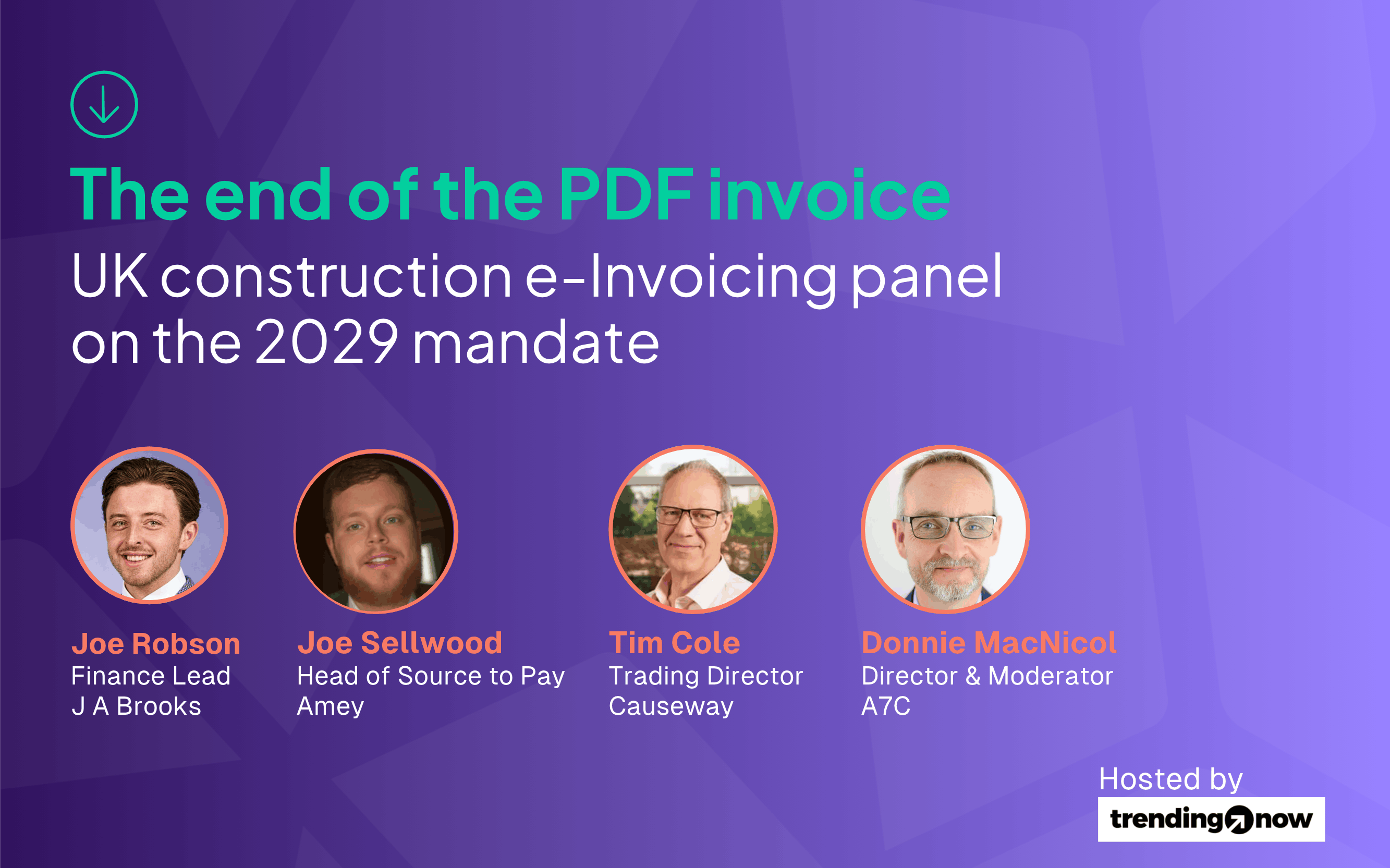
Causeway recently sponsored a Trending Now webinar unpacking what the 2029 e-Invoicing mandate means for construction. It featured Tim Cole, Causeway's e-Invoicing specialist, Joseph Sellwood, Head of Source to Pay at Amey, and Joe Robson, Finance Lead at building services contractor J A Brooks.
In this article, we summarise what the panel said about construction's special cases: what looks unchanged, what's still unclear, and how to prepare. If you'd like the full discussion and live audience Q&A, you can watch the webinar OnDemand.
For the wider picture, read our overview of the mandate.
Where self-billing, CIS and reverse charge stand today
The panel's view was cautiously reassuring. Government has announced no change to self-billing. CIS and the DRC have both been consulted on and are awaiting final confirmation, and nothing has come back to say there's an issue. Government has also identified construction as an area that may need extra time, so more detail is still to come.
Where each item stands today:
-
Self-billing: no change announced.
-
CIS and the domestic reverse charge: consulted on and awaiting final confirmation, with nothing flagged to say they will change.
-
Authenticated receipts: unclear whether they sit inside or outside the mandate.
"The default position from government is change as little as possible, but there are some areas where clarity is still to be given its full underlying detail."
Tim Cole, Industry Director Trading, Causeway
Could authenticated receipts count as invoices?
Possibly, and it's a big open question for construction. It's still unclear whether authenticated receipts will run alongside an invoice process or become invoices in their own right, which would bring them into scope of the mandate. Joseph Sellwood (Amey) said many construction organisations are still working out how self-billing and authenticated receipts will work, and what the legislation will do for that side of billing.
"There's no clarity around whether things like authenticated receipts will require an invoice process in parallel or whether they'll become an invoice, in which case they come into scope. That's a little grey area, which is quite big for construction, but they'll resolve that one way or the other."
Tim Cole, Industry Director Trading, Causeway
Self-billing may gain accuracy while certification stays
The panel suggested that e-Invoicing should improve accuracy and reduce chasing through better invoice visibility. The process itself changes little, because you still need certification by a certain point.. Joseph Sellwood (Amey) added that self-billing carries a huge amount of construction spend, so roles and responsibilities from client to supply chain could change if the rules do.
Retentions came up too. Joseph Sellwood noted that discussions around retentions in the Commercial Payments Bill overlap with some of the same themes as the e-Invoicing mandate, particularly around roles and responsibilities in the supply chain. Joe Robson called retentions another huge point. The bill is separate legislation from the mandate and is still progressing, so it's worth tracking the two separately.
"I think it improves it from a point of accuracy and nothing to chase as much. You can get the status of an invoice, at what stage it's at, but I don't think it changes too much in that respect. You still have to have a certification by a certain point."
Joe Robson, Finance Lead, J A Brooks
Prompt suppliers for their CIS labour and material split
Structured data gives you a place to capture construction detail when the invoice is raised. Joseph Sellwood (Amey) gave an example of what a service provider set-up can do: ask each supplier whether CIS applies and, if it does, for the labour and material split on that invoice.
Fewer administration errors reach the back end, payment profiles improve and your liability to HMRC is correct.
"For example, having a prompt to your supply chain: are you applicable to CIS? Yes or no? If yes, what's your labour versus material split for this invoice? It reduces the administration errors at the back end. Your payment profile is better and, obviously, your liability to HMRC is correct."
Joseph Sellwood, Head of Source to Pay, Amey
Review your sales ledger as well as your creditors ledger
The mandate covers sending and receiving, so both sides of the ledger need attention. Amey's Head of Source to Pay said organisations have put a lot of effort into accounts payable and far less into accounts receivable. The panel's wider advice for construction teams:
-
Look at the creditors ledger and the sales ledger together.
-
Build project plans now, as 2029 is not far away and there's a lot to do.
-
Collaborate across your own business and your supply chain.
-
Involve every function the change touches, including finance, tax and procurement.
"We spent a huge amount of time focusing on the AP side historically, and probably not a huge amount of time or effort on the AR side."
Joseph Sellwood, Head of Source to Pay, Amey
Final e-Invoicing requirements are due by April 2028
The detail for construction is still coming. Tim Cole (Causeway) expects self-billing, CIS and the DRC to carry on as they are now, unless the next consultation round says otherwise. The government roadmap currently sets out the timetable:
-
Spring 2027: a public technical consultation on the proposed UK e-Invoicing standards.
-
October 2027 to April 2028: final requirements published, with at least 12 months' notice before go-live.
-
By April 2028: updated VAT guidance.
-
1 April 2029: the requirement takes effect.
The roadmap says the rules on when a VAT invoice must be issued, and what it must contain, stay unchanged. It says any exemptions will be tightly defined, including to clarify technical points where existing VAT rules have unusual or specific invoicing requirements. It doesn't name CIS, the DRC or authenticated receipts, which is why the panel is still waiting for confirmation.
Key takeaways on self-billing, CIS and reverse charge
-
No change to self-billing has been announced, and the panel expects it to carry on as now unless the next consultation round says otherwise.
-
CIS and the domestic reverse charge have been consulted on and await final confirmation. While nothing has been flagged as changing, the panel noted that detailed guidance is still awaited.
-
Authenticated receipts remain a grey area: they may run alongside an invoice process or become invoices, which would bring them into scope.
-
For self-billing, the mandate is expected to improve accuracy and cut chasing, while certification points stay.
-
A service provider can prompt suppliers for CIS status and their labour and material split, which cuts administration errors.
-
Final requirements are due between October 2027 and April 2028. The Commercial Payments Bill, including retentions, is separate legislation that is still progressing.
-
Start preparing before the final rules are published. The panel's advice is to review both ledgers, build project plans now and involve finance, tax and procurement.
See the live audience Q&A on self-billing and reverse charge VAT, plus the panel's wider discussion of retentions. Watch the full webinar recording OnDemand here.
Nothing has changed so far. The panel said there has been no change in the announcements on self-billing, and expects it to carry on as it does now unless the next consultation round says otherwise. E-Invoicing should add accuracy and invoice status visibility, but certification points still apply.
Not as far as anyone has flagged. CIS and the domestic reverse charge have been consulted on and are awaiting final confirmation, and nothing has come back to say there's an issue. The government's default position is to change as little as possible, but some areas still need full detail.
That's still unclear. Authenticated receipts could run alongside an invoice process, or they could become invoices, in which case they would come into scope. The panel called it a grey area that is big for construction, and expects it to be resolved one way or the other.
A service provider can add prompts to your supplier invoice process. For example, ask whether CIS applies and, if it does, for the labour and material split on that invoice. That reduces administration errors at the back end, improves your payment profile and keeps your liability to HMRC correct.
The Commercial Payments Bill is separate legislation from the e-Invoicing mandate and is still progressing. The panel said discussions about retentions in the bill align with invoicing, because roles and responsibilities from client to supply chain could change. Retentions were described as a huge point for construction.