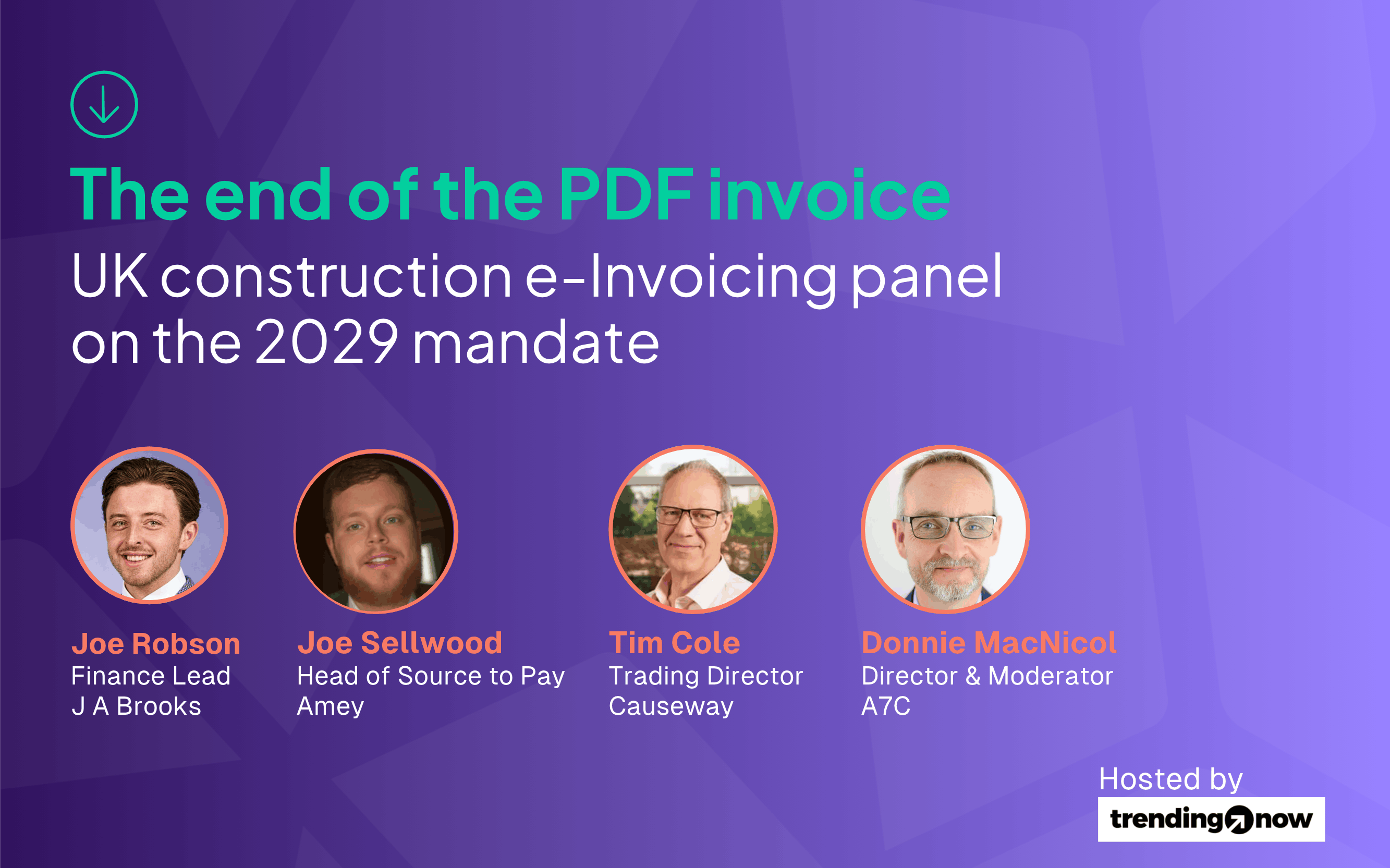
From 1 April 2029, UK businesses will send and receive VAT invoices in a new way. Yet 32% of attendees in a live poll said they hadn't heard of the mandate until the webinar began.
Causeway sponsored a Trending Now webinar unpacking what the 2029 e-Invoicing mandate means for construction. It featured Causeway's e-Invoicing specialist, Tim Cole, Joseph Sellwood, Head of Source to Pay at Amey, and Joe Robson, Finance Lead at building services contractor J A Brooks.
In this article, we'll summarise the key points: what the mandate requires and what the budget confirmed, why the whole supply chain needs to move together, and how to start now. If you'd like the full discussion and live audience Q&A, you can watch the webinar OnDemand here.
What does the UK e-Invoicing mandate require?
From 1 April 2029, all VAT-registered businesses and public bodies must issue and receive business-to-business and business-to-government VAT invoices as structured, machine-readable data. The government has confirmed Peppol as the core interoperability framework, which is a set of rules for formats, standards and verification. It's a framework rather than a physical network.
Two points often get missed. The mandate covers sending and receiving, and many businesses have only done one so far. It also covers every VAT-registered business, whatever its size.
"It affects absolutely all VAT registered businesses. And one point that I think often gets missed is it's senders and receivers of invoices."
Tim Cole, Industry Director (Trading), Causeway
Plenty stays the same. The rules on what an invoice contains and when to raise one are unchanged. It’s the way you exchange invoices that changes.
That includes PDFs and paper. Only structured data counts as the legal invoice. Small senders can still use a PDF as an input: a service provider turns it into a compliant invoice and sends it for them. Receivers need the machine-readable file. A PDF can still be a handy copy to read, but it isn't the invoice itself. Our deep-dive on PDFs covers the detail here.
Budget confirms no phasing and HMRC as Peppol authority
The budget answered the biggest question first. The mandate is going ahead and the timeline hasn't moved. Every business goes live together on 1 April 2029, with no phasing for small companies or particular business types.
It also confirmed what sits outside the mandate:
-
Businesses that aren't VAT-registered
-
Business-to-consumer invoicing
-
Cross-border invoicing
Businesses in these areas are welcome to use the same rules if they choose.
HMRC announced that it will act as the UK Peppol authority, managing the rules and standards itself. The underlying VAT rules stay in place and Making Tax Digital continues.
The panel saw few surprises. Those who took part in the consultation expected most of it. The finance lead at J A Brooks saw the confirmation as a positive step.
"I think it's a real opportunity for businesses like ours to take out unnecessary administration errors. It takes out human error in general and gives you a clear idea of where things stand."
Joe Robson, Finance Lead, J A Brooks
How ready is construction for the 2029 e-Invoicing mandate?
Two live polls showed where attendees stood. In the first, 3% said they were well prepared and 21% had started preparing. Another 45% hadn't started, and 32% hadn't heard of the mandate until the webinar. That puts 77% of respondents at the very beginning.
By the end, the picture had brightened. In the second poll, 8% felt very confident about their next steps and 42% felt fairly confident. The other 50% were either not very confident (42%) or not sure where to start (8%).
The panel named four barriers:
-
Cost
-
Time
-
Understanding
-
The "how"
Joseph Sellwood (Amey) and Joe Robson (J A Brooks) both expect the benefits to outweigh the cost. They worry that organisations will push the mandate down their priority list.
Causeway's e-Invoicing specialist, Tim Cole, rated government messaging as good effort with room to improve, noting that fair payment has had better publicity than the mandate.
"I lost a bet because I did not expect to see 32% of respondents on the poll saying we haven't heard about it."
Tim Cole, Industry Director Trading, Causeway
Move the whole supply chain together
Amey works with more than 5,000 active suppliers a year. 95% of its invoices already arrive electronically. The last 5% has proved the hardest to move, especially for smaller organisations facing platform costs or the time needed to switch to an e-Invoicing portal.
Subcontractor spend adds a big question. At Amey, that spend makes up most of the total.
"80% of Amey's spend is subcontractor. So a huge amount of our spend links into a big question mark at the moment around actually how that's going to work."
Joseph Sellwood, Head of Source to Pay, Amey
The mandate changes the conversation. Ten years ago, Amey asked suppliers to adopt e-Invoicing and few showed interest. Now every business has to take part, so everyone moves together on a level playing field. Businesses can invest knowing they won't need to run paper, OCR and electronic routes side by side.
Each business needs its own inbound and outbound invoices to run digitally. That keeps the challenge local: you solve it for your own business rather than waiting for the layers above or below. Joe Robson added that savings grow when everyone is ready at the same time. Main contractors can help by talking to their supply chain now, explaining what's coming and sharing what worked for them.
Why e-Invoicing pays off beyond the mandate
The panel kept returning to benefits. Digital invoicing has existed for more than 20 years, and everyone who has adopted it has gained. The mandate sets how to do it. The panel's closing message: chase the value, because the mandate arrives either way.
The panel shared concrete gains:
-
Suppliers can send an invoice at the weekend and it's processed before Monday morning.
-
Businesses can send invoice status back to suppliers, so fewer people need to chase.
-
Structured data lifts accuracy to a level you can trust, where OCR still needs checking.
-
The panel also saw AI adding value on top of digital invoices, for example by spotting anomalies and invoice fraud.
Government sees growth, efficiency, fair payment and closing the VAT gap in one change, which is why the specialist expects it to happen.
"Our processing time before we implemented e-Invoicing was 12 days. It's gone down to 2 days with e-Invoicing."
Joseph Sellwood, Head of Source to Pay, Amey
5 steps to prepare your business for e-Invoicing
Details are still coming, but plenty of work can begin today. The panel's advice:
-
Sit down with your accounts payable and receivable teams. Ask how invoices come in and go out electronically today, what you have and what's missing.
-
Map your current invoice routes. See how much arrives by post, email and electronically.
-
Cleanse your master data. Clean data makes every later step easier.
-
Talk to your suppliers early. Explain the change and share what you've learned.
-
Ask for support. Service providers and peers have 20 to 25 years of practical experience to draw on.
Joe Robson pointed out that starting in the new year means you'd already see benefits by April 2029, and Tim Cole seconded that.
"Get started. Don't wait a couple of years. Get going, because the mandate is just deciding how."
Tim Cole, Industry Director Trading, Causeway
Still to confirm: e-reporting, penalties and archiving
More detail is planned over the next two years. These items are in progress, so treat them as forward-looking:
-
E-reporting: a consultation on reporting invoice details to HMRC at the time of exchange runs to January. The panel expects it to follow, with service providers handling the technical side.
-
Finance bill: a bill will update the VAT rules to allow the mandate.
-
Penalties: a framework for compliance is under consideration.
-
Archiving: details on record-keeping are due.
-
Construction specifics: authenticated receipts, CIS and the domestic reverse charge await final confirmation. HMRC has identified construction as an area needing extra time. Our deep-dive covers this here.
-
Final rules: the budget statement set a minimum of 12 months between final sign-off and go-live.
Key takeaways on the 2029 e-Invoicing mandate
- The UK e-Invoicing mandate takes effect on 1 April 2029 for all VAT-registered businesses and public bodies, with no phasing.
- Businesses must send and receive VAT invoices as structured, machine-readable data following the Peppol framework.
- Only structured data counts as the legal invoice. Small senders can still use a PDF as an input to a service provider.
- HMRC will act as the UK Peppol authority. The budget confirmed the timeline and kept the underlying VAT rules in place.
- In a live poll, 77% of respondents hadn't started preparing or hadn't heard of the mandate, including 32% who hadn't heard of it until the webinar.
- Amey cut invoice processing from 12 days to 2 days with e-Invoicing, and 95% of its invoices arrive electronically.
- Final rules are due at least 12 months before go-live. Construction-specific detail on authenticated receipts, CIS and the reverse charge is still to be confirmed.
See the live poll results as they came in, plus the full audience Q&A on self-billing, CIS and reverse charge VAT. Watch the full webinar recording OnDemand here.
No. A business that isn't VAT-registered doesn't issue VAT invoices, so the mandate has no impact on it. Business-to-consumer and cross-border invoicing also sit outside the mandate. Non-VAT-registered businesses are welcome to use the mandated rules and send invoices digitally if they choose.
All VAT-registered businesses go live on 1 April 2029, with no phasing for small companies or particular business types. The budget confirmed the timeline hasn't changed. The budget statement also set a minimum of 12 months between final rules being signed off and go-live, so your team has time to prepare.
Yes. The mandate covers both sending and receiving VAT invoices as structured, machine-readable data. Many businesses have only done one of these so far. Each business needs its inbound and outbound invoices to run digitally, whatever its size, so it's worth involving both your payable and receivable teams.
Only structured data counts as the legal invoice. A small sender can still use a PDF as an input: a service provider extracts the data and sends the compliant invoice on their behalf. A receiver needs the machine-readable file, though a PDF can still serve as a readable copy.
No changes have been flagged so far, and the government's default is to change as little as possible. Final confirmation on CIS and the domestic reverse charge is still awaited. Authenticated receipts remain a grey area, as it's still unclear whether they'll run alongside an invoice or become one.