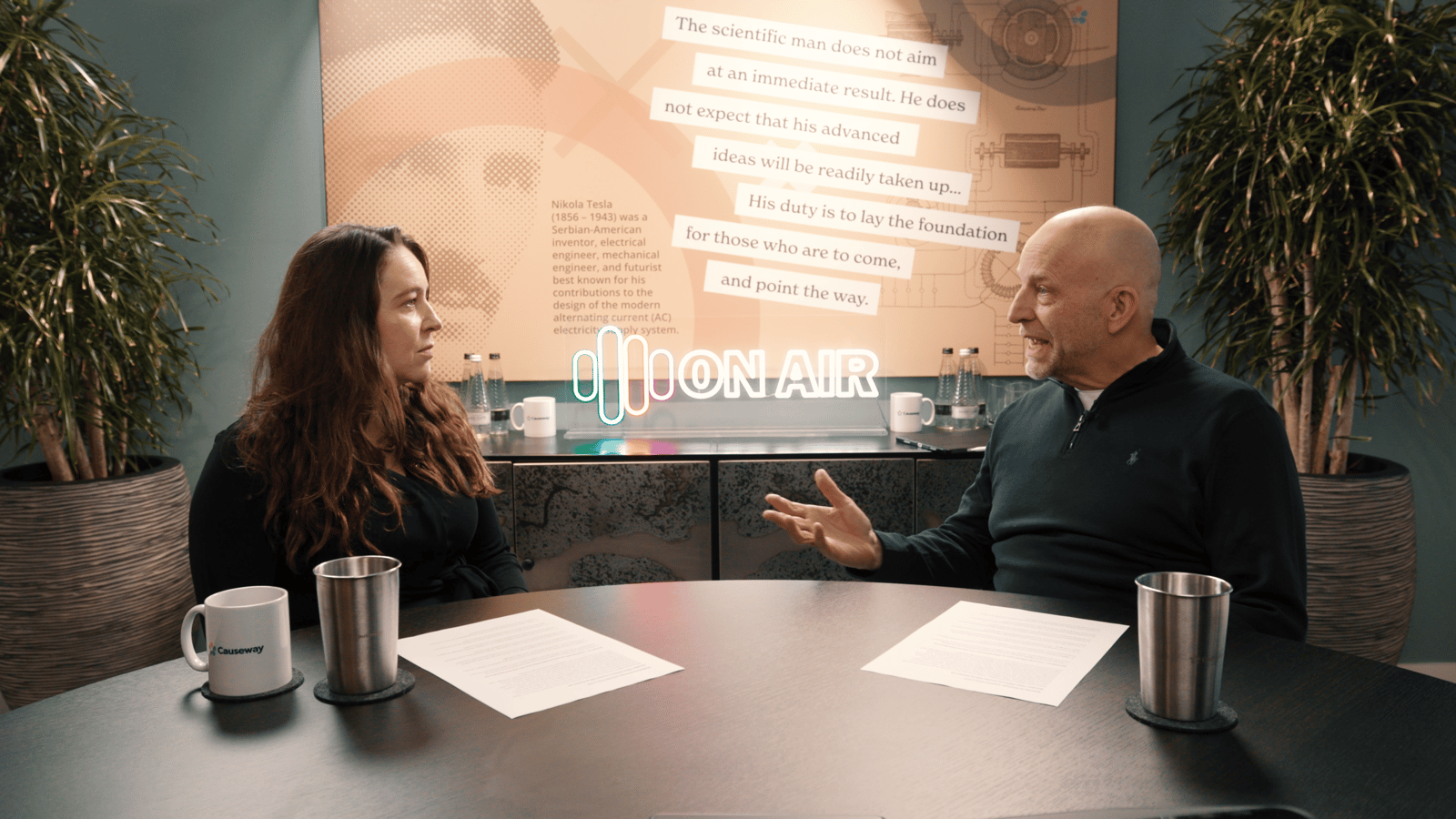
Mike Gibbons spent two decades leading IT and digital strategy at Holcim UK, one of the country's largest construction materials businesses, before stepping down as CIO earlier this year. We sat down with him on our Deconstructing Digital podcast to talk sustainability, data ownership and cybersecurity, but it's his take on AI that stuck with us most.
Mike isn't against AI in construction. Holcim already has it built into live operations. But his view of where it actually works, and where it doesn't, comes from two decades of watching digital initiatives succeed and fail up close, including the same data problem the industry is still working through. Here are three lessons worth taking from that.
1. Start with the problem, not the technology
Mike's clearest point, and the one he came back to more than once, was this: businesses that go looking for a problem to apply AI to tend to fail. Businesses that start with a real, obvious problem and then ask whether AI can help tend to succeed.
His own example is Holcim's ready-mix business in London. Scheduling trucks around traffic and changing conditions was a genuine, visible headache long before AI came into the conversation. Once it did, the technology proved it could schedule better than a person, and the team's job changed rather than disappeared, moving from doing the scheduling to managing and improving on top of it.
.png?width=680&height=355&name=Blog%202%20-%20Image%20Ad%20V2%20(1).png)
That's a useful filter for any business weighing up where to start with AI in construction. If you can't point to the specific pain the tool is meant to remove, you're probably choosing the tool first and hunting for a use case after, and that's the pattern Mike has seen fail most often.
2. AI is only as good as the data underneath it
Mike was direct about this: "AI absolutely relies on good data. It will not work unless the data's good."
That's not a new problem, but it's an easy one to underestimate. He pointed to Holcim's carbon reporting work with Causeway as an example of just how much effort sits behind something that looks simple from the outside. Being able to tell a customer the exact carbon value of a specific product meant getting data right at the source, pulling it accurately out of ERP systems, and making sure it held up once it appeared on an invoice or a delivery note. Get that wrong publicly, and the damage isn't just internal.
The same logic applies to any AI ambition. Before asking what a model can do, it's worth asking whether the data feeding it can actually be trusted. AI doesn't fix a poor data foundation. It just makes the consequences of one more visible, faster.
Listen to the full podcast episode here
3. Give people guardrails, not just access
Mike's other concern was more human than technical: without clear policy, people find their own way to AI, whether or not that's the sanctioned route. At Holcim, that meant setting policy around which AI tools staff are actually allowed to use, rather than leaving it to chance. Even senior leaders, he noted, needed that boundary, since seniority doesn't automatically mean caution.
This isn't about restricting curiosity. It's about making sure the curiosity people naturally have gets channelled somewhere safe, rather than into whichever tool happens to be open in a browser tab.
What can we learn from Mike?
Three lessons, but really one underlying message. Problem-first thinking, good data and clear governance are not separate boxes to tick. They're the same foundation, looked at from three different angles. Skip any one of them, and the other two start to wobble too.
 Mike's twenty years running IT for a major construction materials business boils down to a fairly unglamorous conclusion: get the basics right first. AI works when it's built on top of that. It struggles when it's used to paper over the gaps underneath.
That's also the thinking behind how we're building AI into CausewayOne: not as a feature to chase for its own sake, but as something that only adds value once the data and processes underneath it are solid enough to support it.
Listen to the full episode of Deconstructing Digital with Mike Gibbons for more on sustainability, data ownership, cybersecurity and AI in construction.




.png?width=2666&height=1665&name=CONS_Future%20of%20Construction%20Payments%20Webinar_Feature%20Image%20(1).png)