Plenty of businesses think emailing a PDF counts as e-Invoicing. From 1 April 2029, the UK mandate changes what counts as a valid VAT invoice, and a PDF on its own falls outside it.
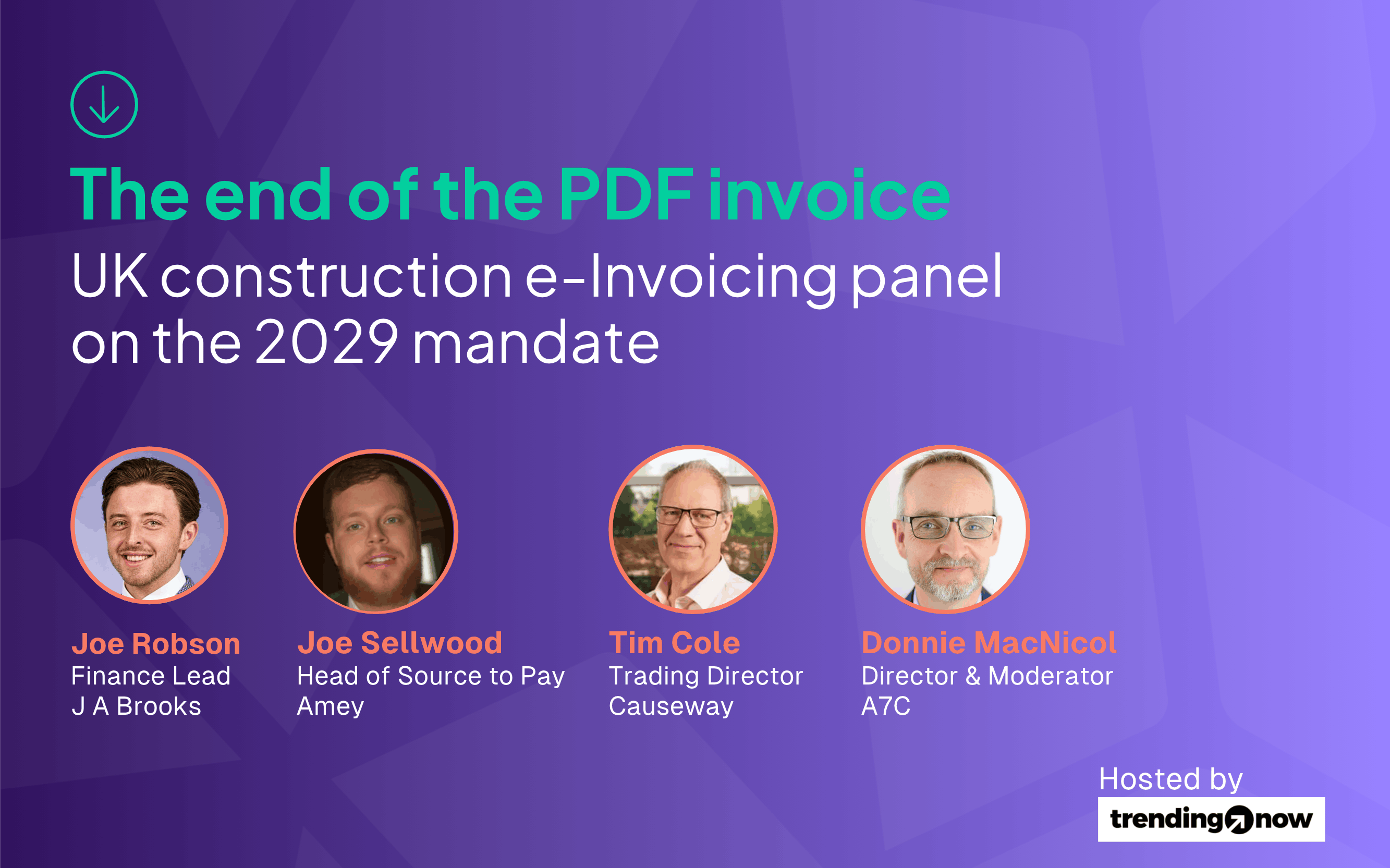
Causeway sponsored a Trending Now webinar unpacking what the 2029 e-Invoicing mandate means for construction. It featured Tim Cole, Causeway's e-Invoicing specialist, Joseph Sellwood, Head of Source to Pay at Amey, and Finance Lead at building services contractor J A Brooks, Joe Robson.
In this article, we summarise what the panel said about PDFs: what counts as a valid invoice, how senders and receivers are affected differently, and how to plan for your smallest suppliers. If you'd like the full discussion, you can watch the webinar OnDemand here.
For the wider picture, read our overview of the mandate here.
Which invoice formats are valid from 1 April 2029?
From 1 April 2029, VAT-registered businesses must send and receive VAT invoices as structured, machine-readable data. PDFs, images and paper no longer qualify as the valid invoice, for senders or receivers.
The panel pointed out that language adds to the confusion. Many people use "invoicing" to mean sending a PDF, so it's worth being precise about the term. The government's aims explain the shift:
-
Cutting business costs
-
Boosting tax compliance
-
Reducing fraud
-
Speeding up payment processing
-
Creating nationwide interoperability between businesses.
To hit those targets, it has been clear from the start that PDFs, images and paper won't qualify.
"Under the mandate, PDF, images and paper are no longer going to qualify as a valid VAT invoice to be either sent or received."
Tim Cole, Industry Director Trading, Causeway
How does a PDF work as an input to a service provider?
Small senders still have a route. A PDF can act as the input to a service provider. The provider extracts the data, creates the compliant invoice on the sender's behalf and sends it. Tim called this the first mile between your system and the world of digital exchange.
That keeps the mandate within reach for micro-businesses. They can work with a partner and keep creating their invoices the way they do today. The legal invoice is the structured file the provider sends, not the PDF.
"For example, I might be able to just get a partner to work with me to create the invoice on my behalf in compliance with the mandate, but I will use a PDF as my input to it. It's not great, but it works."
Tim Cole, Industry Director Trading, Causeway
Receive structured data, not PDFs
Receiving works differently. A contractor can no longer accept a PDF as a valid invoice. The machine-readable file has to arrive. You can still open a PDF to read it, but it's no longer the legal invoice.
For receivers, that means processing becomes fully digital. That's the government's intention, as it wants to move the UK towards a digital economy.
"You can have a PDF if you want to look at it to read it, because that's entirely up to you, but it's not the legal invoice."
Tim Cole, Industry Director Trading, Causeway
Why structured data builds more trust than OCR
The panellists put the benefits in plain terms. Optical character recognition (OCR) reads data from a document, but someone still has to check the results. Structured data arrives in a form your systems can process directly.
Amey has seen the effect first-hand. The panel described three gains:
-
Invoice processing time fell from 12 days to 2 days after Amey moved to e-Invoicing.
-
Businesses can send invoice status back to suppliers, so fewer people need to chase payment.
-
The mandate also lets you stop running paper, OCR and electronic routes side by side.
"We all know what it's like when you use an OCR technology. You still have to check. There's still things that come up that are a little bit wrong. So I think the ‘why’ here is that we're changing to such a high level of accuracy that we can trust more."
Joe Robson, Finance Lead, J A Brooks
Plan for your smallest suppliers
Amey works with more than 5,000 active suppliers a year. 95% of its invoices already arrive electronically. The final 5% has proved the hardest to move, particularly for smaller organisations weighing the cost of a platform or the time it takes to switch.
The mandate changes the picture. Ten years ago, Amey invited suppliers to adopt e-Invoicing and few showed interest. Now every VAT-registered business has to take part, so everyone moves together on a level playing field. For smaller suppliers, the service provider route above gives a practical way in.
"That last 5% has become really challenging to try and move across, especially for smaller organisations where there might be a cost to use the platform or a cost in labour time to actually move yourself across to an e-Invoicing portal or process."
Joseph Sellwood, Head of Source to Pay, Amey
Review your PDF invoice routes in 4 steps
The panel's advice applies to PDFs as much as to the wider mandate:
-
Ask your accounts payable team how invoices arrive today. See how many come by post, by email and electronically.
-
Ask your accounts receivable team how invoices go out. Check what you'd need to send them as structured data.
-
Talk to your suppliers early. Explain that PDFs won't count as the invoice and share what has worked for you.
-
Speak to service providers. They can show how a PDF input works for smaller suppliers.
PDF subtleties, archiving and final rules still to come
Some PDF detail is still to be clarified.
-
PDF subtleties: Tim Cole (Causeway) noted that there are subtleties around PDFs which need confirming.
-
Finance bill: a bill will update the VAT rules to allow the mandate and set the invoice format requirements.
-
Archiving: details on archiving and record-keeping are due.
-
Final rules: the budget statement set a minimum of 12 months between final rules being signed off and go-live, so there's time to prepare.
Key takeaways on PDF invoices and the 2029 mandate
-
From 1 April 2029, PDFs, images and paper no longer qualify as a valid VAT invoice for senders or receivers.
-
Receivers need the machine-readable file. A PDF can still serve as a readable copy.
-
Small senders can use a PDF as the input to a service provider, which creates and sends the compliant invoice for them.
-
Amey cut invoice processing from 12 days to 2 days with e-Invoicing.
-
95% of Amey's invoices arrive electronically, and the final 5% is the hardest to move.
-
Some PDF detail is still to be confirmed, and final rules are due at least 12 months before go-live.
See the full explanation of how senders and receivers handle PDFs differently, in Causeway's e-Invoicing specialist's own words, plus the audience Q&A on suppliers that aren't VAT-registered. Watch the full webinar recording OnDemand here.
No. From 1 April 2029, PDFs, images and paper no longer qualify as a valid VAT invoice, whether you send or receive them. The legal invoice is the structured, machine-readable file. Some detail on PDFs is still to be confirmed, so it's worth following updates.
Yes, as an input. A small or micro-business can send a PDF to a service provider. The provider extracts the data, creates the compliant invoice on its behalf and sends it. The specialist described this as a practical method that keeps businesses within reach of the mandate.
You can still receive a PDF to read, but it's no longer the legal invoice. As a receiver, you need the machine-readable file to arrive. That means processing becomes fully digital, so it's worth asking your accounts payable team how invoices reach you today.
The panel gave five aims: cutting business costs, boosting tax compliance, reducing fraud, speeding up payment processing and creating nationwide interoperability between businesses. To hit those targets, the government has been clear since the start that PDFs, images and paper won't qualify as the valid invoice.
No. A business that isn't VAT-registered doesn't issue VAT invoices, so the mandate has no impact on it. These businesses are welcome to use the mandated rules and send digitally if they choose, but they sit outside the mandate.